
Most first gardens fail underground and overhead, not at the garden centre: plants chosen for a photograph die in shade, and beds dug into exhausted soil starve all season. The garden tips decoradhouse that matter come first — read your sun, test your soil, plan your water, then choose plants.
Key Takeaways
- Map your sun before planting anything: hours of direct light, tracked across a day and across seasons, decide what can possibly thrive.
- Learn your soil with three cheap tests — texture by hand, drainage by a filled hole, and acidity by a kit — before spending on plants.
- Treat water as built infrastructure rather than a daily favour: fix where it comes from, how it travels to each bed, and how long the soil keeps it after you stop.
- Lay out beds you can reach across, paths you can push a barrow along, and lawn only where it earns its upkeep.
- Mulch obeys arithmetic, not optimism: multiply bed length by width, settle the depth once, and let that volume — not a guess at the till — set both the order and its cost.
Why Should Garden Tips Decoradhouse Start With Sun, Soil and Water?
Plants are the last decision in a garden, not the first, because three fixed conditions decide which plants are even possible. Sun decides the menu: a bed that receives three hours of direct light will never ripen tomatoes happily, no matter how hopefully they are fed, and a sun-trap against a south wall will scorch the shade plants a catalogue described as easy. Soil decides the cooking: the same plant flourishes in one garden’s loam and sulks in the next garden’s compacted clay, and the difference is invisible until you dig, squeeze and drain-test what you actually own.
Water decides whether the first two decisions survive July. A garden planned around a distant tap and good intentions is a garden watered thoroughly in May and apologetically in August, and plants experience that as a drought with a guilty owner. The garden tips decoradhouse collected here therefore run in a strict order — observe the sun, test the soil, design the water, draw the layout — and plant shopping is deliberately last, because every one of the first four steps is cheaper to change on paper than in the ground.
This foundation-first order also protects the later articles in this series from repetition: seasonal care, planting calendars and clever shortcuts all assume a garden whose sun, soil and water are already understood. A reader who builds the foundations once can use every later tip at full strength, while a reader who skips them will keep meeting the same three problems wearing different plants. Foundations are unglamorous for exactly one weekend; a badly founded garden is unglamorous for years.
How Do You Map the Sun’s Path Across Your Own Garden?
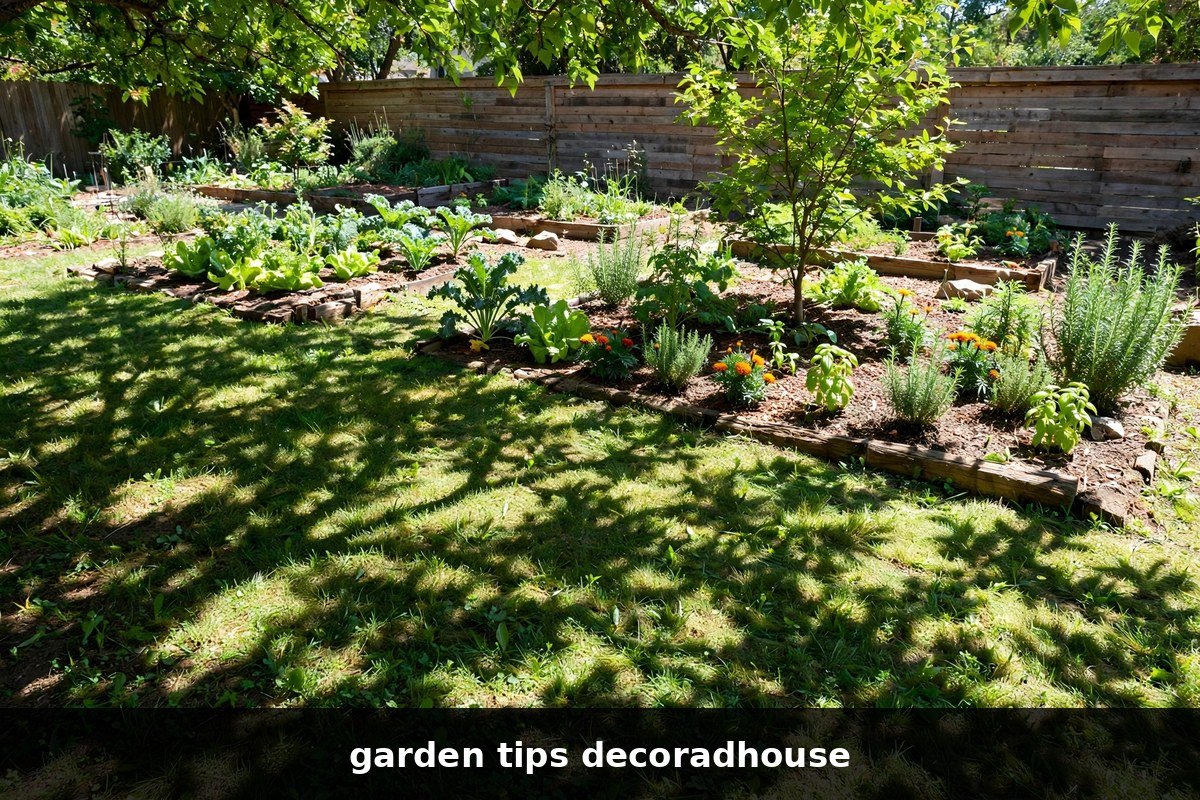
Spend one honest day watching light move across the plot, because memory is a flattering liar about sunshine. From morning to evening, note which areas hold direct sun and for how long, sketching the pattern at roughly three points in the day — after breakfast, at midday and in the late afternoon — and marking the shadows cast by fences, walls, trees and the house itself. A phone’s photographs, taken from the same spot each time, make the record impossible to argue with later.
Translate the sketch into three zones and treat them as planting law. Full sun means six or more hours of direct light and suits most vegetables, roses and Mediterranean herbs. Partial shade means roughly three to six hours, or dappled light through a canopy for much of the day, and suits a wide, forgiving range of perennials and leafy crops. Full shade means under three hours of direct light, and the honest options there are shade specialists, foliage texture and hard landscaping that stops apologising for the dark.
Repeat the exercise mentally for the season you are not in. A bed that basks in April sun may sit in a fence’s shadow by December, and a deciduous tree offers kind summer shade over a lawn while letting winter light through to the beds beneath — one of the few genuinely free lunches in gardening. Note also the microclimates a simple map reveals: the frost pocket at the bottom of a slope where cold air settles, the wind tunnel between two buildings, and the warm strip along a brick wall that can carry a plant rated one zone tenderer than your garden.
| Direct sun per day | Honest description | What reliably thrives there |
|---|---|---|
| 6 hours or more | Full sun | Most vegetables, roses, lavender and other Mediterranean herbs |
| Roughly 3 to 6 hours | Partial shade | Leafy crops, many perennials, foxgloves, hardy geraniums |
| Under 3 hours | Full shade | Ferns, hostas, ivy and foliage-first planting |
| Dappled, through canopy | Light shade | Woodland plants, spring bulbs under deciduous trees |
What Should You Know About Your Soil Before Planting Anything?
Dig before you diagnose, because soil is identified by behaviour, not by appearance from the patio. The squeeze test asks for nothing but a handful of moist soil, closed in your fist and opened again. Sand falls apart the moment you open your hand and drains faster than roots can drink; clay holds a firm sausage shape, keeps every footprint and drowns roots in a wet winter; loam — the gardener’s prize — holds together loosely, crumbles under a poke and behaves well in both drought and flood. Most real gardens are a mixture leaning one way, and knowing the lean decides everything from drainage work to plant choice.
For drainage, all the equipment you need is one dug hole, one bucket of water and the patience to watch an hour of your afternoon pass. Dig a hole roughly a spade’s depth, fill it with water, let it drain away, then fill it again and time the second draining: water that disappears within a few hours suits most planting, water that lingers into the next day warns of compaction or a high water table, and the honest responses are raised beds, drainage work or plants that enjoy wet feet — chosen deliberately, not discovered by drowning. A simple acidity kit from any garden shop completes the trio, because a strongly acidic or alkaline soil will lock some nutrients away from roots no matter how generously you feed.
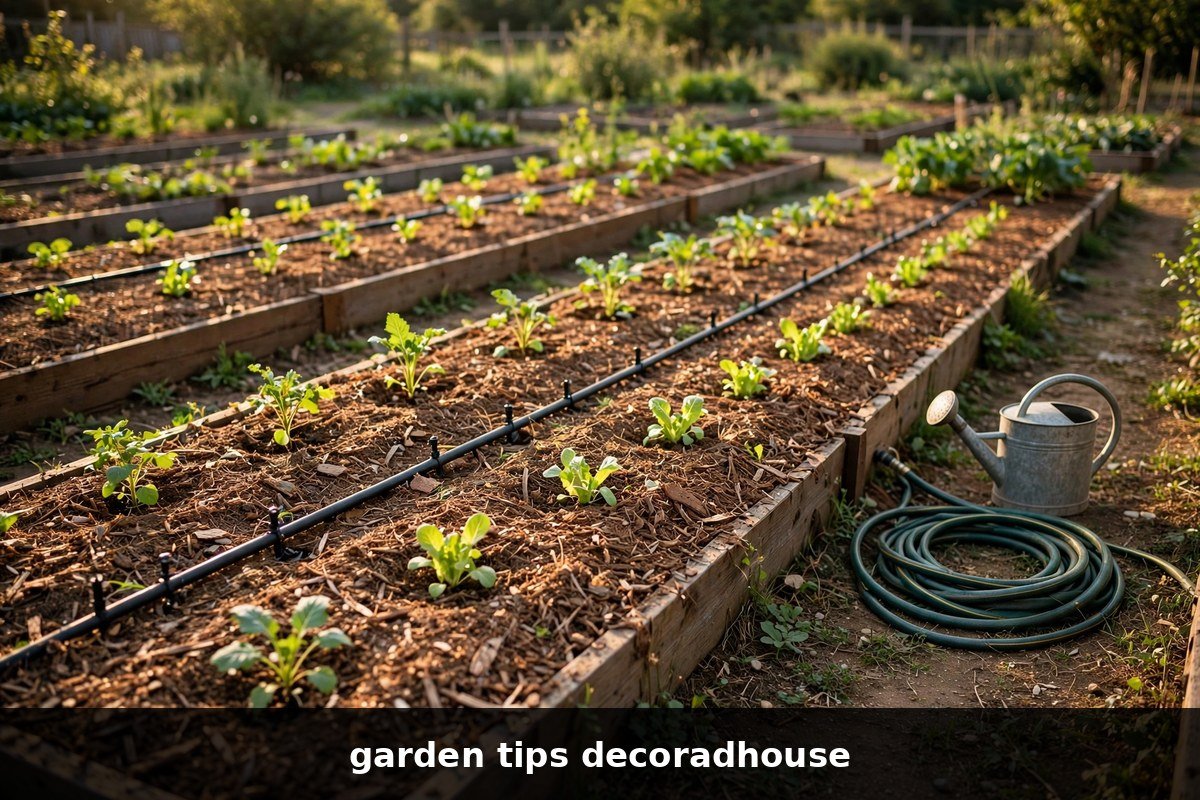
Improvement arrives in the form of organic matter, applied generously and then patiently, season after season. Compost, well-rotted manure and leaf mould worked into the top layer — or simply spread as a mulch and left for worms to incorporate — improve sand’s thirst and clay’s temper at the same time, which is why experienced gardeners feed the soil and let the soil feed the plants. Mulch itself is arithmetic before it is shopping: measure each bed’s length and width, decide a depth that suppresses weeds without smothering crowns, and run the figures through the Mulch Calculator so the volume you order matches the beds you own rather than the optimism you brought to the garden centre.
How Should Water Reach the Garden, and How Much Is Enough?
Design watering as plumbing, not as a daily act of devotion. The questions are physical: where is the nearest outdoor tap, how long a hose truly reaches the farthest bed without crossing a path as a trip hazard, and would a simple drip line along the main beds remove the summer’s most repeated chore? A buried drip line or a porous soaker hose admits water into the soil in a slow trickle exactly above the roots that will drink it, so almost nothing is surrendered to wind drift or midday evaporation, and because the stream never arcs through the air the way a sprinkler’s does, the leaves above the bed stay dry — and dry leaves deny several common leaf diseases the damp foothold they need in order to begin.
Timing matters as much as quantity. Watering in the early morning lets roots drink before the day heats up and lets any splashed leaves dry quickly, while evening watering leaves foliage damp overnight and midday watering in high summer loses a visible share to the air. Deep, less frequent watering trains roots downward toward moisture that persists, whereas a daily sprinkle keeps roots lounging at the surface, perfectly placed to suffer in the first hot week you spend away from home.
Storage completes the system, because roof water is free and gardens are thirstiest exactly when mains water is most restricted. A water butt under a downpipe will not irrigate a whole garden through a drought, but it will carry the pots, the seedlings and the newest plantings — the three groups that die first — through a dry fortnight. Place storage before the layout hardens, since a butt needs a downpipe, a stand and a short, level route to where its water will actually be carried.
How Do You Lay Out Beds and Paths You Can Actually Maintain?
A layout is a promise about your future behaviour, so draw the garden you will maintain rather than the one you will photograph. Beds earn a working width from their access: a bed against a wall or fence can only be tended from one side, so it stays within a comfortable arm’s reach in depth, while an island bed tended from both sides can be roughly twice that — any wider and its centre becomes a no-man’s-land of weeds you can see but cannot touch without standing on the soil you just improved.
Paths are infrastructure, not decoration, and they should be sized by their traffic. The main route — the one travelled with a mower, a barrow or a load of compost — deserves a firm, level surface wide enough for that traffic to pass without clipping the planting on both sides, while a stepping-stone spur to the compost heap can stay informal. Every path drawn on the plan is also a confession about where feet will go anyway; a layout that ignores the desire line from the back door to the gate will find that line worn through its lawn by February.
Lawn deserves an honest interview before it is granted half the plot. Grass is the right surface for children, dogs and sitting out, and an expensive, thirsty, weekly chore everywhere else — so grant it the areas where it will genuinely be used, shape it in curves a mower can follow without three-point turns, and let beds, ground cover or gravel take the awkward margins where grass only ever grew apologetically. The layout that results is smaller, denser and more interesting, and its maintenance fits the hours a real household actually has.
| Garden element | Size that works in practice | Why it works |
|---|---|---|
| Bed against a wall or fence | Within one arm’s reach in depth | Every plant reachable for weeding and tying in without standing on the soil |
| Island bed | Roughly twice the one-sided depth | Tended from both sides, its centre stays reachable |
| Main path | Wide enough for a barrow and its carrier to pass planting cleanly | Compost, mower and harvest traffic uses it weekly for decades |
| Lawn edge | Curves a mower can follow in one pass | Edges stay crisp without constant trimming and re-cutting |
The Limits of Foundation Advice
Foundations decide what is possible, but they do not decide the weather, and every garden keeps a share of gambling no preparation removes. A late frost after a mild spell, a summer of rain in a garden planned for drought, or a new building next door stealing two hours of mapped sun will each rewrite part of the plan, and the correct response is adjustment rather than despair — the maps and tests are baselines for noticing change, not contracts with the climate.
The tests themselves are honest but approximate. A squeeze test will not give you a laboratory’s nutrient analysis, a one-day sun map misses the year’s extremes, and drainage behaviour in a wet spring says little about the same soil in a cracked August. Gardeners who need precision — before an expensive planting scheme, or where a tree’s health is in question — can buy a laboratory soil analysis for less than the cost of replacing three wrongly chosen shrubs, and that trade is usually worth it.
Finally, foundations cannot choose your plants’ hardiness for you, and no layout rescues a plant asked to live outside its climate. Check every candidate against your area’s frost reality and your plot’s own microclimates, and treat catalogue optimism as advertising rather than evidence. Sun read honestly, soil known by its behaviour, water planned as plumbing and beds drawn to a reachable size — those four foundations carry a first garden further than any plant list, and they are exactly where good gardens quietly begin.
Frequently Asked Questions
How many days should you watch your garden’s light before planting anything?
One full day of sun-watching across three sittings is the minimum that produces a usable map, and a week of casual attention is better, because a single day can be unusually cloudy or still. Gardeners with patience earn the best data of all — a full season shows the sun map changing as fences and trees cast different shadows — but a first garden should not wait a year: map the day, note the obvious seasonal traps, and plant the forgiving things first.
What is the simplest soil test that actually tells me something?
The squeeze test on a handful of moist soil separates the three families that matter — sand that will not hold a shape, clay that holds a firm sausage, and loam that holds together loosely and crumbles — and that single distinction drives most early decisions about drainage, watering frequency and improvement. Add the filled-hole drainage test before planting anything expensive, and a shop-bought acidity kit before choosing plants known to be fussy about it.
How deep should mulch be, and how do I know how much to order?
A mulch layer needs enough depth to shade the soil and suppress weed seedlings without burying plant crowns — in practice a layer you can still see your knuckles through when you press a hand flat is too thin, and a layer that mounds against stems is too deep. For quantity, multiply each bed’s length by its width to get its area, decide the depth once, and run the figures through a mulch calculator: bed arithmetic, not guesswork, is what prevents the second delivery or the leftover heap.
Is a drip system worth it for a small garden?
For beds that will be watered weekly through a dry season, usually yes, because the system’s real saving is not water but attention: a drip line on a simple timer delivers slowly to the root zone at the right hour whether or not you are home, and small gardens need only short runs of pipe. Pots and hanging baskets remain hand-watering territory, since their soil volumes are too small and too exposed for buried lines to serve well.
Can I fix clay soil, or should I just build raised beds?
Either route can succeed — the difference is the amount of ground you must fix and how many seasons of steady improvement you are prepared to give it. Clay improved with generous organic matter, year after year, becomes genuinely good soil, and its nutrient-holding power is an asset once its drainage is civilised — but the improvement is measured in seasons, not weekends. Raised beds give you controlled soil this spring at the price of materials and faster drying in summer, so many first gardens do both: beds for the impatient crops, and steady improvement for the ground itself.
Conclusion
Read plainly, garden tips decoradhouse are a promise to spend your effort in the only order that works: one day watching the sun, three simple tests learning the soil, water designed as plumbing rather than remembered as a chore, and beds drawn to the size your arms and your barrow can honestly serve. Build those four foundations first and plant shopping becomes the pleasure it was supposed to be, because every plant you bring home finally has a known place to succeed. For more home improvement advice you can measure, visit smart decoratoradvice.