Smart home ideas earn their place by doing a job — sensing, deciding, acting — the household does by hand or not at all. The decoradtech smart home ideas by decoratoradvice here are surveyed by room and function, each sized by a measurement in the room it will serve.
Key Takeaways
- An idea qualifies as smart only when it senses something, decides something, or acts on a schedule or trigger — a remote-controlled gadget doing one manual job is a toy, not a system.
- Survey by room and job, not by product: lighting, climate, security, water and entertainment each have a first idea that earns its keep before any second one is added.
- Every idea is sized by a measurement in its own room — area for climate, distance for sensors, coverage for Wi-Fi — taken before anything is bought.
- Climate is the quiet win: scheduled, right-sized heating and cooling saves energy in a way lighting scenes never will.
- Ideas are not installations: connectivity, privacy and compatibility limits are named honestly in the limits section.
What Makes an Idea a Smart Home Idea?
Three verbs separate a smart home idea from a gadget purchase: sense, decide, act. A device that senses — temperature, motion, water, light — gives the house information it did not have. A device that decides — comparing that information against a schedule or a rule the household set — removes a recurring human judgement. A device that acts — switching, dimming, locking, shutting off — completes the loop without anyone crossing the room. An idea that does all three, or plugs honestly into a system that does, changes how the house behaves; an idea that does only one, with a phone app standing in for the missing two, changes only how the household fiddles.
That test disciplines the survey that follows. Each room below is given its jobs first — the recurring tasks the household performs there by hand — and the ideas are admitted only where they take over one of those jobs completely enough to be forgotten. A smart home that must be remembered, charged, updated and apologised for has failed its only brief: the best ideas in this article are the ones a visitor would never notice, because the house simply behaves as if someone thoughtful were always awake in it.
Which Ideas Belong in the Living Room?
The living room’s jobs are light, shade and entertainment, and its first idea is layered light under one control: the main light, the lamps and any accent lighting answering a small set of scenes — full, evening, film, away — instead of a handful of switches in the wrong order. The measurement that sizes it is the room’s switching map: which fittings exist, which are dimmable, and where the household actually sits, because a scene designed from the doorway fails the sofa. Done well, this is the idea guests feel without naming — the room is simply always lit the way the evening wants.
Shade follows light in the same room: blinds or curtains that close on a schedule or a light sensor turn the room’s largest surface into a climate tool, holding summer sun out and winter warmth in. Entertainment control — one remote logic for television, sound and streaming — earns its place only third, because it organises pleasure rather than labour. The survey’s order is deliberate: ideas that manage light and heat run every day of the year, while the perfect film-night scene runs on Fridays.
What Does the Kitchen Gain?
The kitchen’s smart ideas are safety ideas wearing convenience’s clothes. First among them is water sensing: a leak sensor under the sink, behind the dishwasher and beside the washing machine’s supply, alerting at the first cupful rather than the first ceiling stain downstairs. The measurement is placement, not specification — the sensor must sit where water actually pools, which the household learns from the floor’s own low spots and the plumbing’s real routes, not from the product photograph.
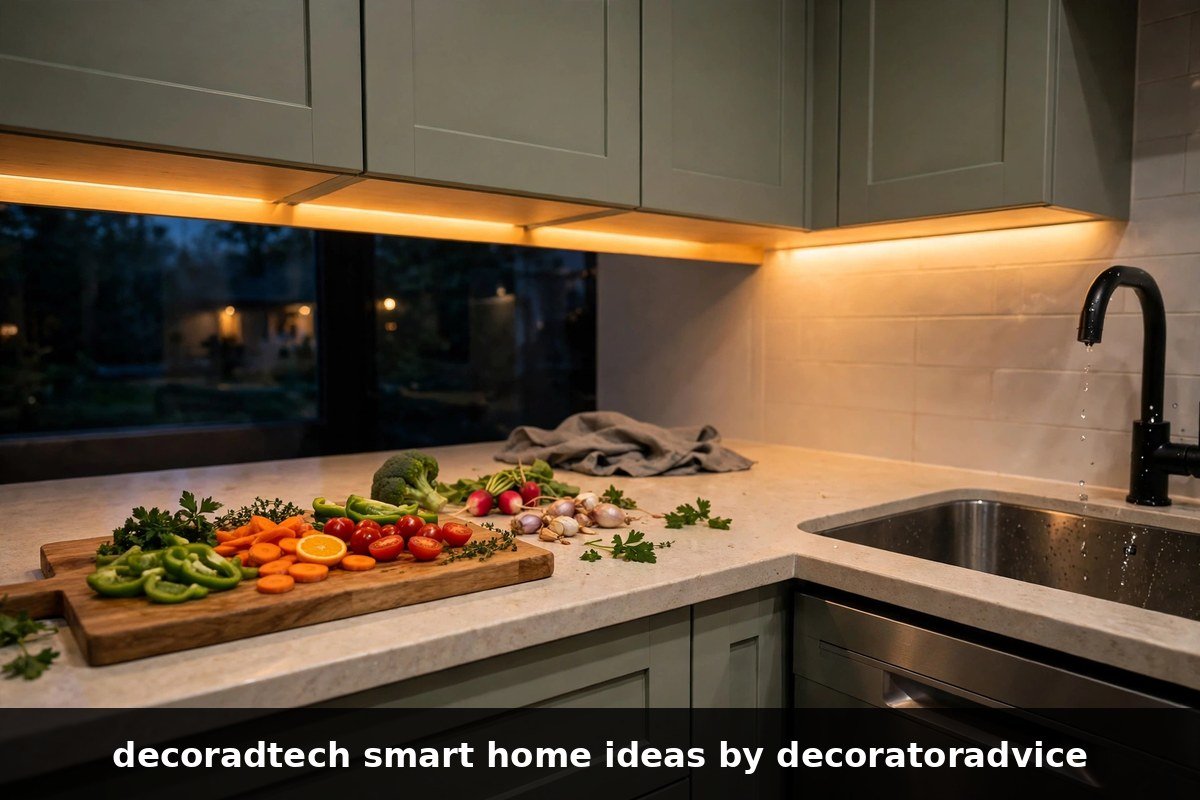
Second is light where hands work: under-cabinet lighting on a motion or schedule trigger, sized by the counter’s length, so preparation surfaces are lit without a switch touched by wet hands. Third, and deliberately last, come appliance alerts — a fridge door left open, a cycle finished — useful, but luxuries beside a leak caught early. The kitchen teaches the survey’s sharpest lesson: in the room where water, heat and electricity share a counter, the smartest idea is the one that notices trouble, not the one that plays music.
How Does Climate Become the Quiet Win?
Climate is where smart ideas stop being theatre and start being arithmetic. A smart thermostat that learns or is scheduled honestly — lower while the house is empty or asleep, recovering before anyone returns — trims the largest energy load in most homes; ENERGY STAR’s estimate for certified smart thermostats is roughly eight per cent of heating and cooling costs, on the order of fifty dollars a year, earned invisibly. The idea’s discipline is the schedule’s honesty: a thermostat programmed for a household that is never out saves nothing, and the survey’s first climate act is to write the week’s real occupancy before touching a dial.
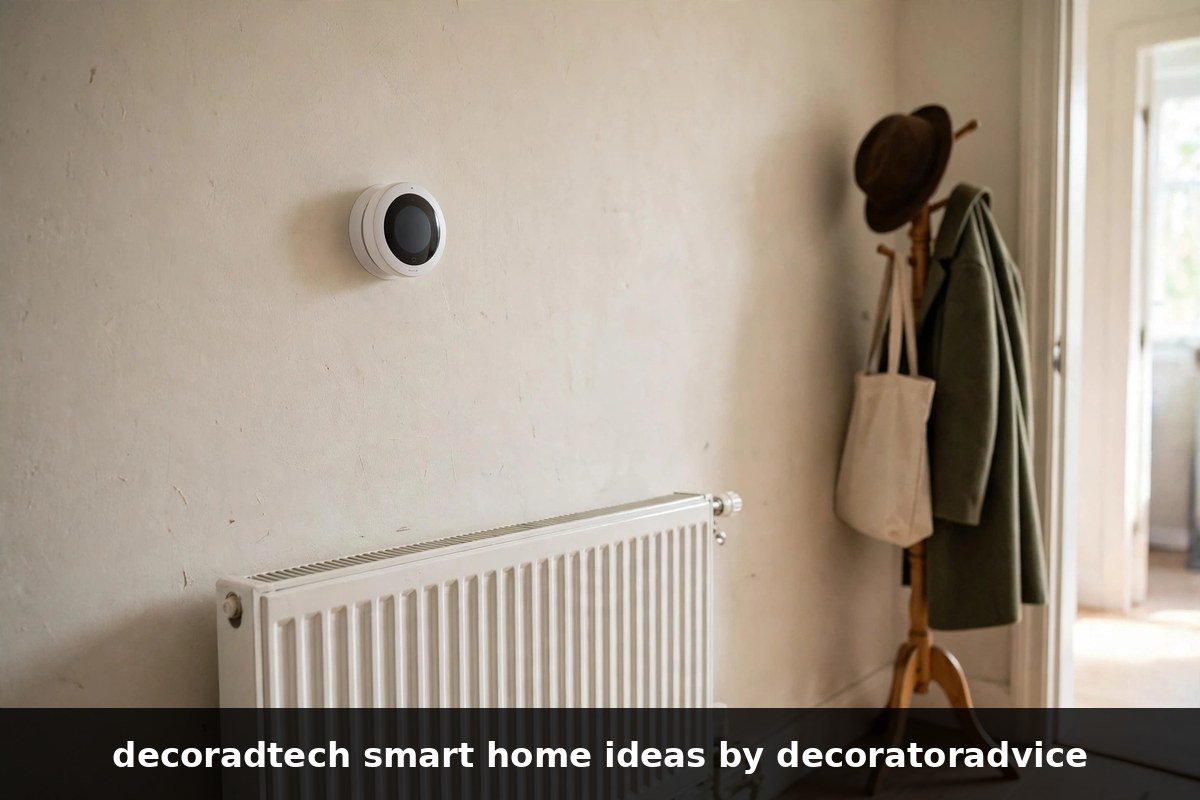
Room-level ideas extend the same logic: a temperature sensor in the room actually occupied, rather than the hallway the thermostat happens to inhabit, and heating or cooling sized to the space it serves. Where a room is conditioned by its own unit — a split system, a portable unit, supplementary heat — the sizing question comes first, and the room’s dimensions, run through the BTU Calculator, give the capacity the space needs before any smart control is layered on top of it. A clever controller on a wrongly sized unit automates discomfort very efficiently. Zoning ideas — smart vents, radiator valves — belong after the basics, in houses whose layout genuinely splits into used and unused territory.
| Function | The first idea that earns its place | The measurement that sizes it |
|---|---|---|
| Lighting | Scenes under one control in the main living room | The switching map: fittings, dimmers, where people sit |
| Climate | A scheduled smart thermostat with a room sensor | The week’s real occupancy, and each room’s dimensions |
| Water safety | Leak sensors at the sink, dishwasher and supply lines | Where water actually pools — the floor’s low spots |
| Security | Entry sensing with alerts that distinguish doors | Which entries exist and which are actually used |
| Entertainment | One control logic for screen and sound | The devices present and the remotes they brought |
What Should Security and Entry Ideas Do?
Security ideas succeed when they notice the unusual and ignore the ordinary, and that is a harder brief than it sounds. The first idea is entry sensing: contacts on the doors the household actually uses, with alerts that distinguish a door opened at noon from one opened at three in the morning. The measurement is the household’s real entry pattern — doors, times, the dog’s garden trips — because a system that cries wolf over its own family’s ordinary comings and goings teaches everyone to switch it off, and a silenced alarm protects nobody.
The second idea is presence simulation: lights and shades following a lived-in pattern while the house is empty, varied enough to read as occupancy rather than machinery. Video at the entry belongs third, and its measurement is the approach itself — the path a visitor or a parcel takes, the light that path has at night — rather than the camera’s specification sheet. Security bought by specification frightens the household; security designed from the household’s own patterns protects it quietly.
How Do Ideas Cover Water and Safety Beyond the Kitchen?
Water travels, and the survey follows it: the bathroom’s leak sensing at the cistern and the bath’s overflow points, the utility corner’s sensor at the water heater — the appliance whose failure empties a tank across a floor — and, where the plumbing allows, a main-line monitor that learns the house’s flow and flags the pattern of a hidden leak. Each is the kitchen idea repeated at a new address, which is the point: safety ideas scale by placement, and the household’s plumbing map is the survey document that places them.
Air and alarm complete the safety layer: smoke and carbon monoxide detection that alerts the phone as well as the room, and indoor air sensing where a household has a reason — a wood stove, a workshop, a nursery. These ideas share one specification that matters more than any other: they must still work, loudly and locally, when the internet does not. A safety device that falls silent with the router has inverted its purpose, and the limits section returns to that condition.
The survey, gathered onto one page, reads as rooms rather than products:
| Room | First idea | The idea that follows it |
|---|---|---|
| Living room | Lighting scenes under one control | Shade that closes on light or schedule |
| Kitchen | Leak sensing at sink and machines | Counter lighting on a trigger |
| Entry and hall | Entry sensing tuned to real patterns | Presence simulation while away |
| Bathroom and utility | Leak sensing at cistern and heater | Alarms that alert the phone as well |
| Bedrooms | A temperature sensor where people sleep | Climate zoning once basics behave |
The Limits of Smart Home Ideas
Ideas are not installations, and three limits govern everything above. The first is connectivity: most smart behaviour leans on the home network and often on a manufacturer’s cloud, so an outage, a discontinued service or a changed subscription can retire a device the hardware outlives — the survey favours ideas whose core job survives locally. The second is privacy: sensors that know occupancy, routines and voices hold a map of the household’s life, and where that map is stored, and who can read it, is part of every idea’s real specification.
The third limit is fragmentation: devices speak different standards, and an idea that works alone may refuse the system the next idea needs. Compatibility is therefore a survey question, asked before the first purchase rather than discovered at the fifth. None of these limits argues against the ideas; they argue for choosing them as this article has — by job, by room, by measurement — so that what enters the house earns its place and keeps it.
Frequently Asked Questions
Where should a beginner start?
With one room and one job done completely — usually the living room’s lighting or the home’s thermostat schedule — rather than a device in every room doing half a job. A single idea that senses, decides and acts, and is then forgotten, teaches the household what it actually wants automated; the second idea is chosen from experience instead of advertising.
Do all smart devices need a hub?
No. Some devices connect directly through Wi-Fi and their own apps, some use a hub or bridge, and some join wider standards designed to mix brands. The honest answer is per device and per system: the hub question belongs in the survey for each idea, because a house of five apps and no centre behaves very differently from a house with one system and a shelf of compatible parts.
What happens when the internet goes down?
It depends on the idea, and the difference matters. Local schedules, sensors and alarms with local logic usually keep working; cloud-dependent features — remote access, voice control through a distant service, some alerts — pause until the connection returns. Safety ideas in particular should be chosen for local behaviour first, which is why this survey treats connectivity as a limit, not a footnote.
Can renters use these ideas?
Many of them, yes — the ideas that sense and act without altering the building: plug-in sensors, leak detectors that sit rather than plumb in, lamps and shades controlled at the plug or the fitting. Ideas that rewire, re-plumb or replace the landlord’s fixtures are owners’ territory. The survey’s room-by-room order works either way; only the fitting method changes.
Do smart ideas actually save energy?
The climate ideas do, measurably, when the schedule matches the household’s real life — the thermostat estimate in the climate section is the honest scale of it. Lighting saves a little where it replaces forgotten switches. Most other ideas save attention, water damage or worry rather than energy, and claiming otherwise for them would be salesmanship, not survey.
Conclusion
Gathered room by room, decoradtech smart home ideas by decoratoradvice reduce to a discipline: admit only ideas that sense, decide or act on a real job, size each by a measurement in its own room, and let climate and safety outrank theatre. A house improved that way does not feel futuristic; it feels attended. That preference for ideas measured against real rooms runs through everything published at smart decoratoradvice.