

A retrofit succeeds in phases — network first, then light and climate, then security — because a home’s wiring, Wi-Fi and habits set limits new-build plans never meet. This home upgrade decoradtech sequence checks those limits before buying and counts running costs as it grows.
Key Takeaways
- A retrofit is not a smaller new-build: the existing house — its wiring age, wall materials and Wi-Fi dead spots — writes the plan, and the checks come before the shopping.
- Phase one is always the network: coverage measured room by room, the router placed and named properly, because every later phase stands on it.
- Lighting and climate follow, favouring no-rewire options first — bulbs, plugs and sensors before switches — where the wiring argues against surgery.
- Security and entry come later deliberately: they depend on the network and on habits the earlier phases have taught the household.
- Running cost is part of the upgrade: standby draw and subscriptions are summed honestly before the system grows teeth.
Why Does a Retrofit Need Phases?
A new-build smart home is designed on paper, wired before the walls close, and switched on as a single act. A retrofit meets the opposite conditions: walls already closed, wiring from another era’s assumptions, a router wherever the line happened to enter, and a household living inside the work. Phasing is how the retrofit respects those facts. Each phase is small enough to finish, cheap enough to judge, and reversible enough to forgive — and each phase’s lessons rewrite the next phase’s list, which is precisely what a single grand installation cannot do.
The phases in this article follow dependency, not glamour. The network precedes everything because everything speaks through it. Light and climate follow because they are daily, forgiving, and teach the household its own preferences in automation. Security waits because it is none of those things — it is unforgiving of weak networks and wrong assumptions, and it deserves to arrive in a house that already knows how its systems behave. Entry, entertainment and the long tail of convenience fill the later phases, bought with experience instead of optimism.
What Must Be Checked Before Any Device Is Bought?
Four checks, all measurable, all free. The first is Wi-Fi coverage, walked rather than assumed: stand in each room with a phone, note the signal where devices would actually live — the far corner, the garden-facing wall, the bathroom — and mark the dead spots on a rough plan. Walls of masonry, foil-backed insulation and distance each tax the signal differently, and the map, not the router’s box, states the truth. The second check is the electrical reality: the consumer unit’s age and spare ways, the presence of neutral wires at light switches — older wiring often omits them, which decides whole families of devices in or out — and the count and placement of sockets where actors would plug in.
The third check is the household’s own infrastructure of habits: which phones, which voice — if any — the family will actually use, who is the house’s willing administrator, and which routines are real enough to automate. The fourth is the building’s permissions: for renters and leaseholders, which fittings may be replaced at all. A retrofit plan written after these four checks is a plan for this house; one written before them is a plan for a catalogue’s house, and the difference shows up as returns, dead spots and one blinking device nobody can explain.
| Check | What it reveals | The decision it drives |
|---|---|---|
| Wi-Fi walked room by room | Dead spots and weak corners, marked on a plan | Router placement, mesh nodes, which rooms phase later |
| Switch wiring opened and looked at | Whether neutral wires exist at the switches | Bulbs and plugs first, or switches allowed |
| Consumer unit and sockets surveyed | Spare capacity and where power actually is | Which actors can be fed, and where |
| Household habits written down | Real routines, real administrator, real phones | What is worth automating at all |
What Is Phase One — the Network Foundation?
Phase one buys no visible magic, which is why impatient retrofits skip it and pay for the skip in every later phase. Its work is placement and order: the router moved as central and as high as the house allows, out of the cupboard and away from the metal and masonry that smother it; coverage re-walked against the phase-zero map; a mesh node or a wired access point added where the map says the signal dies, and only there. Its second work is naming and organisation — one network name the whole house uses, a guest network for visitors and lesser devices, and a written record of what connects where, kept by the household’s administrator.
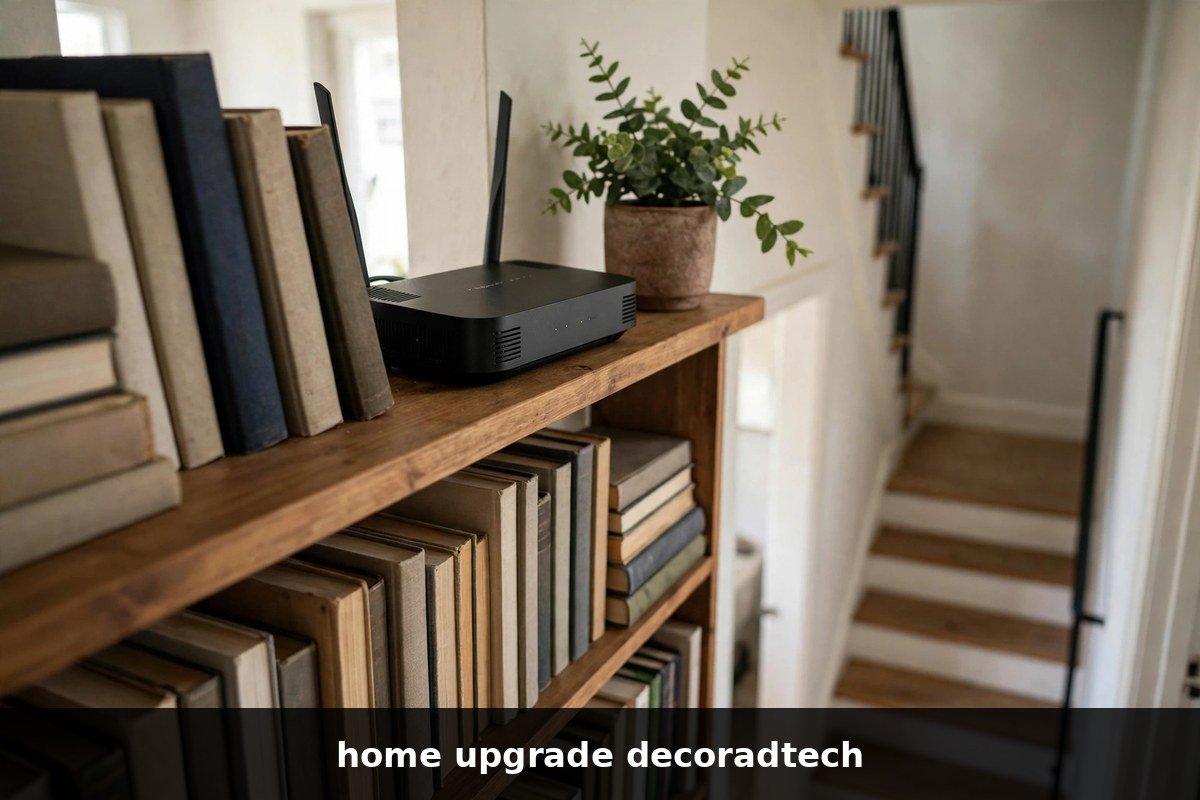
The phase’s test is boring and absolute: every room that a later phase will touch shows a strong, stable signal at the spots devices will occupy, at the hours the house is busiest. A retrofit that passes phase one finds later devices pairing first time and staying paired; one that fails it generates the classic smart-home folklore — devices that drop, scenes that half-fire — blamed on the devices when the foundation was the fault. Phase one also sets the pattern the whole upgrade follows: measured, finished, written down, then built upon.
Which Upgrades Come Next — Lighting and Climate?
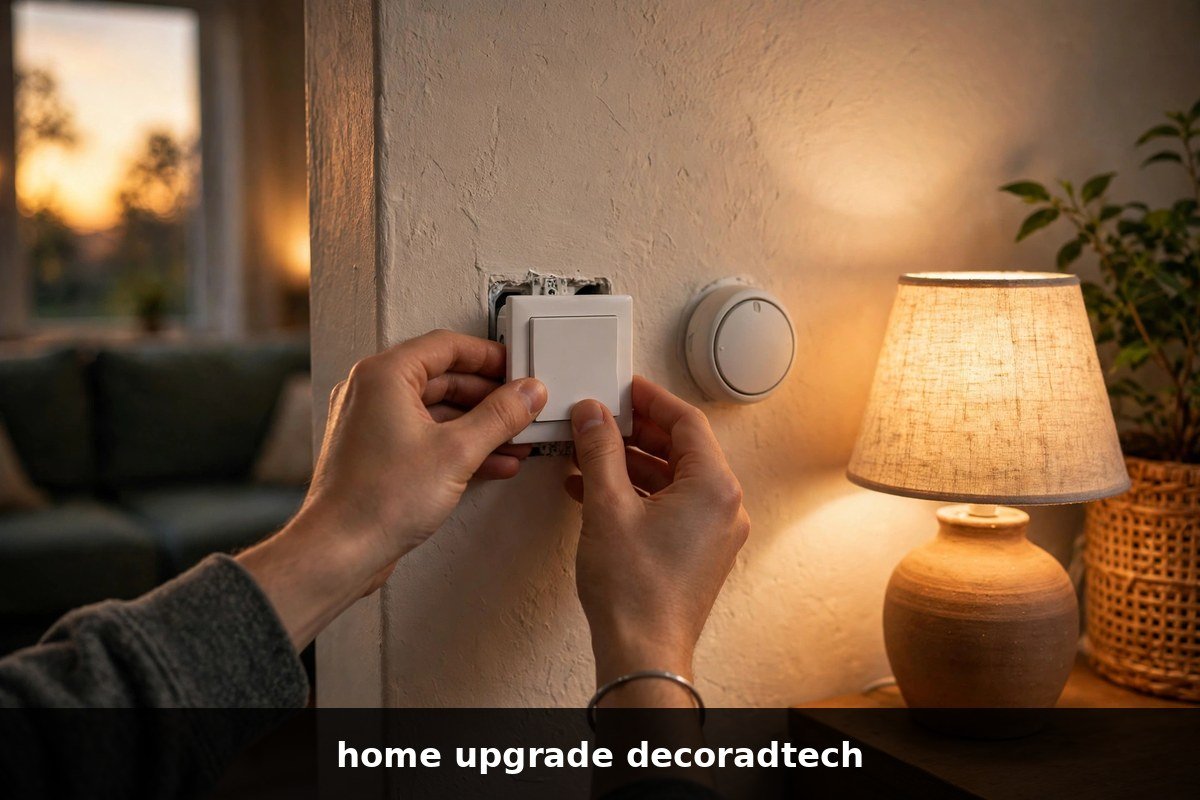
Phase two takes the rooms’ light, by the route the wiring check allowed. Where neutrals exist at the switches, smart switches make the room’s fixed lighting obedient while keeping the wall control everyone expects. Where they do not, the retrofit goes around the wiring instead of through it: smart bulbs in the lamps and fittings that matter, plugs for the plug-in lights, and no shame in either — the behaviour, not the fitting, is the upgrade. Scenes are kept few and named by the life they serve, and every automated light keeps a manual way to defeat it, because a guest, a child or a future owner should never need the app to find the bathroom at night.
Climate shares the phase because it shares the lesson: control follows measurement. The thermostat upgrade — scheduled honestly against the week’s real occupancy — is the phase’s anchor, and room sensors correct its hallway blindness. Portable and room-level heating or cooling joins only where its sizing has been done from the room’s dimensions. The phase ends with a review the impatient skip: a month of living with the automations, deleting the scenes nobody uses and promoting the ones everybody misses when they fail. A retrofit is edited like a text, and phase two is where the household learns to edit.
How Do Security and Entry Fit the Later Phases?
Security arrives in phase three, onto a network already proven and habits already observed. Entry sensing comes first — contacts on the doors the household truly uses, alerts tuned by the patterns phase two revealed — then the entry itself: a lock whose checks are the door’s own measurements, fitted only when the door’s alignment is honest. Video at the approach follows, placed by the path’s light and the parcels’ reality rather than by the widest advertised angle. Presence simulation, which needs the lighting phase beneath it, completes the set: the house performing occupancy with the very scenes the household taught it.
The order is the security. A lock installed in phase one, on a weak network in a house whose routines are still guesses, produces alerts nobody trusts and a door nobody enjoys. The same lock in phase three inherits a strong signal, a known administrator and alert patterns tuned to a real life — and quietly becomes infrastructure. Retrofits fail at security more than anywhere else, and almost always because it was scheduled by excitement instead of by dependency.
| Phase | What it adds | Disruption, honestly stated |
|---|---|---|
| One — network | Router placement, coverage, naming, records | An afternoon; no walls touched |
| Two — light and climate | Switches or bulbs, thermostat, room sensors | An hour a room; one circuit off at a time |
| Three — security and entry | Contacts, lock, entry video, presence scenes | A door’s worth of fitting; alerts tuned over weeks |
| Later — convenience | Entertainment control, shades, appliance alerts | Bought singly, with experience, or not at all |
What Does It Cost to Run?
An upgrade is bought once and paid for continuously, and the retrofit that ignores the second price grows resented. The first running cost is standby: every always-listening, always-connected device sips power around the clock, and a house of dozens of sips has a measurable thirst. The method is the same list discipline used for sizing — each device’s standby draw, from its specification, summed across the system — and that total, run through the Electricity Cost Calculator, turns an invisible creep into a number the household can judge before the fleet grows.
The second running cost is subscriptions: storage for video, features moved behind fees, monitoring services. Neither cost argues against the upgrade; both argue for counting it at phase size rather than at catalogue size. A system whose running cost was chosen deliberately is maintained gladly; one whose cost is discovered bill by bill is a system being quietly unplugged, device by device, back into the drawer economy the retrofit was meant to end.
The Limits of Retrofitting
Three limits bound the whole project. The first is the building itself: wiring that cannot support a device family, walls that defeat signal and cannot be chased, listed or rented fabric that may not be altered — the checks reveal these early, but they do not repeal them, and some houses honestly top out at phases one and two. The second limit is churn: standards, apps and manufacturers change faster than houses do, so every phase should be bought to be worth its cost even if its maker vanishes — local control and standard fittings are the insurance.
The third limit is the household: an administrator who leaves, a family that never wanted scenes, a routine that changes with a new job or a new baby. The retrofit that survives is the one whose automations serve the life actually lived and can be edited by the people living it. Phasing is the protection here too — a house upgraded in small, judged steps can stop at any landing and still call the work finished.
Frequently Asked Questions
Can an old house be made smart without rewiring?
Largely, yes — that is what the phased route is designed for. Bulbs, plugs, battery sensors and a well-placed network deliver most behaviours without touching the wiring; only some switch and hardwired device families truly need the neutral wire older houses lack. The wiring check exists precisely to draw that line room by room instead of discovering it mid-purchase.
Where does the money actually go?
Disproportionately on the unglamorous: the network foundation, the thermostat, the lock — and then in a long tail of small devices whose individual prices hide their sum. The phase budget is the honest instrument: each phase priced whole, including its running cost, before it begins. Households are rarely surprised by a phase they priced; they are surprised by a house they priced as a single shopping trip.
What if the Wi-Fi is weak in one room?
Then that room phases later, after the network answer exists — a mesh node, a wired access point, or a relocated router — rather than receiving devices that will drop and be blamed. The coverage map from the checks says which rooms are ready; the retrofit’s discipline is simply believing its own map.
Should working devices be replaced to match one brand?
Rarely for the brand’s sake; sometimes for the system’s. If a translating controller or a shared standard already lets the existing devices behave, replacement buys a logo, not a behaviour. Replacement earns its cost when a device cannot join the system, cannot be controlled locally, or carries a subscription the household refuses — behaviour reasons, each one checkable.
How long does a retrofit take?
Phase one is an afternoon; phase two, a few weekends at an hour a room; phase three, a fitting day plus weeks of alert tuning that happen by living, not by labour. The honest total is a season of small steps rather than a week of upheaval — and the house remains fully liveable on every landing in between, which is the retrofit’s whole advantage over the grand installation.
Conclusion
Phased and checked, home upgrade decoradtech is less a purchase than a negotiation with the house as it stands: its wiring read, its signal mapped, its habits believed, and each phase finished and judged before the next is bought. The result is not a show home but a house that quietly cooperates — and can stop cooperating at any landing and still be complete. Houses measured before they are modified are the subject of everything at smart decoratoradvice, where the tape measure and the coverage map both outrank the catalogue.