

Writing a useful decoratoradvice.com contact message starts with a measured project, a clear single question and the details a stranger would need to picture your room accurately. This guide explains what to include, what to leave out, and what to expect in return.
Key Takeaways
- This site currently publishes no email address, phone number, postal address or contact form, so any address for it circulating elsewhere should be treated with caution.
- A good project message names the room, the goal, the measurements taken, the timeline, the budget band and one clear question, in that order.
- Passwords, payment details, identity documents and publicly posted home addresses should never appear in a first message to any advice service.
- Measured questions with real numbers attached are the ones that earn usable answers, because they let the reader answer for your actual room.
- Genuine emergencies such as a gas smell, active flooding or exposed live wiring belong with local emergency and licensed services, never with a website inbox.
What Contact Routes Does This Site Actually Publish?
The honest answer, checked against the live site in November 2026, is that this site publishes no direct contact route at all: there is no email address listed on the homepage, no phone number, no postal address and no contact form anywhere on the pages a reader can reach. The closest thing to a contact statement anywhere on the site appears in its coverage of partnerships, where a business interested in working with the site is told, in plain terms, that it can make contact through the site itself — a sentence that describes an intention rather than a channel, because it names no address, no form and no inbox a reader could actually use today.
That absence is worth stating plainly, because it protects you in two directions at once. First, it stops you wasting an evening hunting for a form that does not exist when the answer you need is very likely already sitting inside the site’s free guides and its 43 calculators, which are organised into seven categories, need no sign-up and were built so that common project questions could be answered with measurements instead of correspondence. Second, it arms you against imitations: if you find an email address or submission form somewhere else claiming to be this site’s official contact route, treat it with genuine caution, because the site itself has published no such thing, and an invented inbox is a well-worn way of harvesting personal details from people who only wanted to ask about paint quantities.
It also helps to be clear about what kind of thing you would be contacting even if a channel existed. This site is a publishing resource — a library of measured guides ranked by evidence, plus calculators that turn room dimensions into material quantities — and it is not a contractor marketplace, not a design studio selling individual plans and not a directory that books tradespeople on your behalf. Its standing rules reflect that publishing role: no paid placements influence what the guides recommend, and a contingency of fifteen percent is held back on every budget the site discusses (twenty percent for homes built before 1980). A message to a resource like this is a question about published guidance, not the opening of a job booking. Most questions that feel like contact questions are answered faster by the site’s guides, and the reader’s guide to using the site shows how to find the right one for a real project.
What Should a Good Project Message Include?
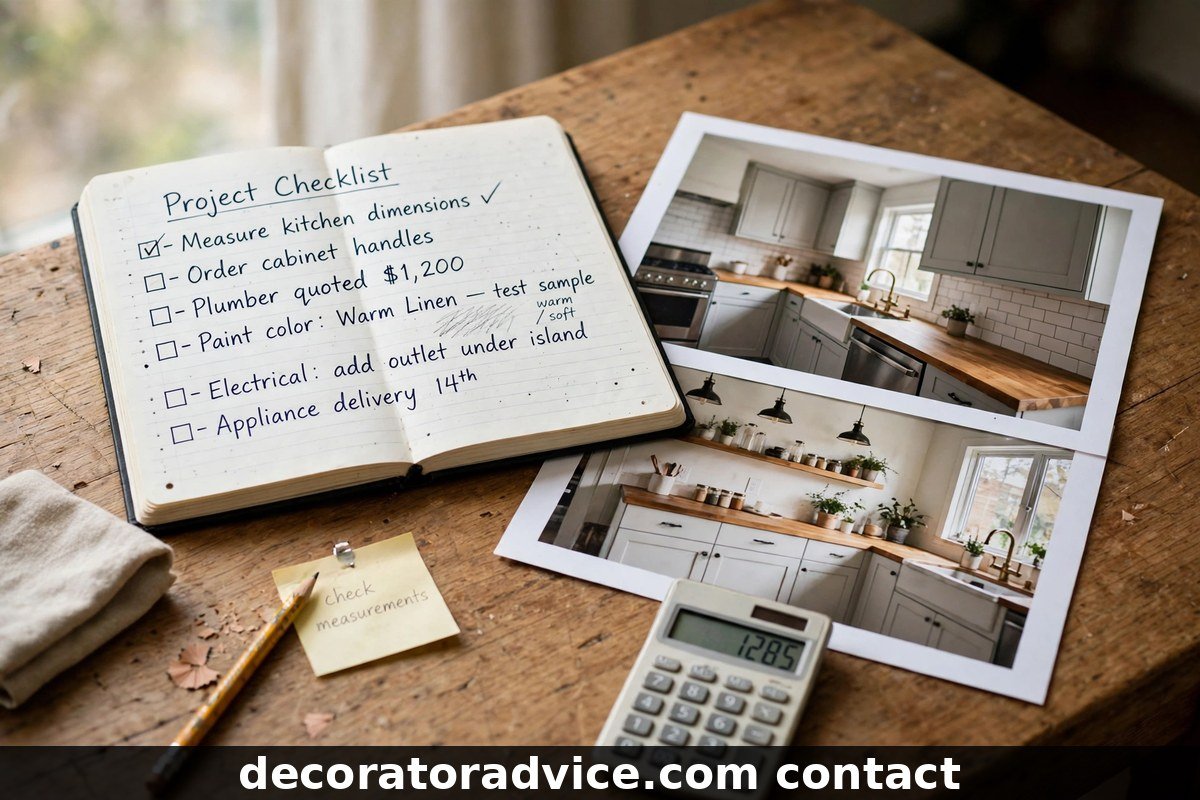
Whenever you write to any home-advice site, editor or professional, the messages that get useful answers share the same skeleton, because they hand the reader everything needed to picture the job without a follow-up round of questions. Start with the project type and the goal stated as an outcome rather than a product: “I want a hallway that survives two children and a wet dog” tells a reader far more than “which paint,” because it explains the wear and the cleaning regime the finish has to withstand rather than naming the first product that came to mind.
Next, name the room or area precisely and give its dimensions, because almost every useful answer in home improvement is secretly an arithmetic answer wearing a disguise. Measure before you write — the length, the width, the ceiling height, the doors and windows that break up the walls — and run those figures through a tool such as the Square Footage Calculator so that your message can say “the room is 132 square feet with one wall mostly window” instead of “the room is medium-sized,” a phrase that means something different in every house it has ever been used in. A message carrying real measurements can be answered with quantities and waste allowances; a message without them can only be answered with generalities, and generalities are what the guides already give away free.
After the measurements, add your timeline and your budget band, stated honestly rather than optimistically, because both quietly determine which advice is even possible. A reader who knows the work must finish before a baby arrives in March, and that the money available sits in a modest band with the sensible fifteen percent contingency already protected inside it, will steer you towards the contained refresh you can actually complete instead of the beautiful multi-stage project that would strand you with a half-finished room. Finish with what you have already read or tried — the guide you followed, the finish that peeled — and then ask one clear, single question, because a message asking three questions usually gets the easiest one answered and the important two forgotten.

What Should You Never Send?
The never-send list matters as much as the checklist, because a first message to any service — however legitimate it looks — should contain nothing that could harm you if it were forwarded, breached or sent to the wrong inbox by mistake. Never send passwords or account credentials of any kind, since no advice service needs to log into anything on your behalf in order to tell you how much tile a bathroom requires. Never send payment card numbers, bank details or photographs of identity documents, because advice is either free or a properly invoiced professional service; it is never paid for by card details typed into a message box. Never post your full home address publicly alongside interior photographs and your holiday dates, a combination that tells a stranger where the valuables are and when the house will be empty, and be wary of large unrequested attachments — full plan sets and survey documents — which reveal more about your property than any opening question requires.
The reassuring test is simple: a legitimate advice service can do its entire job with your room dimensions, your goal, your timeline and your question, and it will never ask for the rest. The moment a supposed advice channel requests credentials, payment details or identity documents before it will answer a decorating question, the correct move is to stop writing, because you are no longer talking to an advice service in any meaningful sense.
| Include in your message | Leave out |
|---|---|
| The project type and the outcome you want | Passwords or account credentials of any kind |
| The room or area, named precisely | Payment card numbers and bank details |
| Measurements already taken, with units | Photographs of identity documents |
| The timeline the work has to meet | Your full home address posted publicly |
| An honest budget band, contingency protected | Holiday dates alongside interior photographs |
| What you have already read or tried | Large unrequested plan sets and attachments |
| One clear, single question | Anything you would not want forwarded |
What Should You Expect After You Write to an Advice Site?
Expectations deserve the same honesty as the contact routes themselves, because small publishing sites are typically run by small teams whose first job is the next guide, not an inbox, and no response time can be promised here on this site’s behalf — inventing one would be exactly the kind of false precision this site exists to argue against. What can be described fairly is the general pattern across small advice publishers: a short, measured question that a guide almost answers tends to be picked up and answered, or folded into a future revision of that guide, far more readily than a long, open-ended request for a personal design service the site does not offer.
It is also realistic to expect that the answer, when it comes, will be general guidance pointed at the relevant published material rather than a bespoke plan drawn for your house, because the person replying has not stood in your room, tested your walls or checked your wiring, and responsible advice says so instead of pretending otherwise. If your question turns out to need a site visit, a structural opinion or a regulated trade, the most useful reply you can receive is a short one telling you exactly that and naming the kind of local professional who should decide it — a success, not a brush-off, because it has stopped you spending money on the strength of an email. Business and partnership questions are covered in the site’s partnership coverage, which is also where the site’s only contact-related statement appears.
| Message type | What helps it get a useful answer | Realistic expectation |
|---|---|---|
| A measured question about a published guide | Room dimensions, the guide named, one clear question | The most likely kind to be answered or folded into a guide revision |
| A correction or update to published figures | The page named, the figure quoted, your source | Genuinely welcomed by evidence-led sites and usually checked |
| A request for an individual design or plan | A clear statement of budget and scope | A polite redirect; publishing sites do not sell individual plans |
| A partnership or business enquiry | Who you are, what you propose, in two short paragraphs | Considered against the site’s published no-paid-placement rules |
| An urgent problem at home | Nothing — do not write | No inbox is monitored for emergencies; use local services |
The Limits of Contacting a Publishing Site
Even a perfectly written message runs into limits that no wording can fix, and knowing them in advance keeps a slow reply from feeling like a personal failure. A publishing site offers no emergency service of any kind. If you can smell gas, if water is actively coming through a ceiling, or if wiring sits exposed and live, the people to contact are your local emergency number, your utility’s emergency line, or a licensed tradesperson who can stand in the room today — anything that can flood or ignite within the hour is finished long before an emailed question receives its first reading.
There are also whole categories of answer a website cannot responsibly give you at any speed. It cannot produce an individual design plan for your home, sign off a structural change, certify that a wall is not load-bearing, or tell you that a particular electrical alteration is safe in your jurisdiction, because every one of those judgements depends on physical inspection and local regulation rather than on information a message can carry. What it can do — and what this site’s guides and calculators are built to do — is give you the measurements and evidence-ranked comparisons that let you walk into a conversation with a local licensed professional already knowing what questions to ask.
Frequently Asked Questions
Is There an Email Address for the Site?
No email address for this site is published anywhere on the site itself as of November 2026, and neither is a phone number, a postal address or a contact form. Because nothing official has been published, any address or form you find elsewhere claiming to represent this site should be treated with caution rather than used, and the practical route to an answer is the site’s own free guides and calculators.
How Do I Ask About a Specific Project Without a Contact Form?
You prepare the question exactly as this guide describes — project, room, measurements, timeline, budget band, one clear question — and then work through the published material with that prepared question in hand, because a question sharpened to that degree usually finds its answer inside the relevant guide or calculator within minutes. Keeping it saved also means that if a contact route is ever published, or you put the same question to a local professional instead, the work is already done.
What Details Make a Project Message Easier to Answer?
Measurements do more work than any other detail, because they convert your question from an opinion request into an arithmetic problem with a definite answer, and definite answers come quickly and confidently. After measurements, the honest budget band and the real timeline matter most, since together they rule out the suggestions that would waste your time, and a note of what you have already tried prevents the reply from recommending the very thing that has already failed in your house.
Should I Send Photos or Plans With My First Message?
A first message should describe the room in words and numbers rather than carrying photographs or plan documents, because attachments raise privacy questions, often exceed inbox limits and are rarely needed before the reader knows whether the question is one they can answer. If the person replying later asks for a photograph of a specific detail — a crack, a junction, a manufacturer’s label — send that single image then, cropped to the detail itself.
What Should I Do About an Urgent Problem at Home?
Treat anything involving gas, electricity, structural movement or uncontrolled water as a local emergency rather than a question for any website, and contact your emergency services, your utility provider’s emergency line or a licensed local tradesperson immediately, turning off the relevant supply at the stopcock, consumer unit or meter only where it is safe to do so. An inbox is read by writers in office hours, and the gap between that rhythm and an active leak is exactly where expensive damage happens.
Conclusion
A well-built decoratoradvice.com contact message, measured and specific about the project in front of you, is the fastest route to advice that actually fits your home rather than a house that exists only in a guide’s examples. This site publishes no email address, form or phone number today, and it has been honest about that here rather than inventing one, because the evidence-first habit behind its rankings should govern how it talks about itself. Until a route exists, the prepared question remains the valuable part: measure the room, protect the contingency, ask one thing clearly, and let the free guides and calculators do their job. For more home improvement advice you can measure, visit smart decoratoradvice.