

decoratoradvice .com partners are the topic sites that publish alongside smart decoratoradvice under one shared standard: DecoradHouse, DecoradTech and DecoradYard. Each partner owns its specialty, shares the same free calculator library, names its sources, and is held to the same measured, no-paid-placement rules.
Key Takeaways
- The partners are the site’s own topic family — DecoradHouse, DecoradTech and DecoradYard — not outside advertisers or lead buyers.
- Each partner publishes only in its own specialty: home decorating and exteriors, smart home devices, or the garden and yard.
- Every partner works to the same evidence standard: figures traced to named reports, assumptions stated, outdated numbers corrected openly.
- The 43 free calculators are shared across the whole family, and guides point readers to whichever partner fits their project.
- Partnership here never means paid placement, pay-to-rank coverage, sponsored rankings, or selling reader details.
Who Are the decoratoradvice .com partners?
On most websites, the word partners is a warning sign. It usually means advertisers, sponsors, or companies paying for placement, and it leaves readers guessing which recommendations were earned and which were bought. Here, the word means something narrower and more honest. The partners are the topic sites in the same family as smart decoratoradvice, each one publishing in its own specialty, all of them held to the same measured standard summed up in the site’s tagline: Home improvement advice you can measure.
DecoradHouse covers decorating, renovation and home exteriors — the rooms, surfaces and outside walls of the house itself. DecoradTech covers smart home devices and how to set them up, from heating controls to lighting and the home systems behind them. DecoradYard covers the garden, backyard and terrace: planting, paving, outdoor structures and the projects that start where the back door ends. Around them, the main site keeps the measurable core of improving a home — the guides, the project rankings and the calculator library that the whole family shares.
A partner is not a company that paid to be listed, and it is not a contractor waiting for leads. It is a publishing partner: a site with its own topic, its own readers, and a shared obligation to show its working. When a guide on one partner site reaches the edge of its topic, it points the reader to the partner that covers the next step — the way a renovation guide here might send you to DecoradHouse for exterior finishes, to DecoradTech for the smart thermostat that follows the building work, or to DecoradYard when the project moves outside.
| Partner | Specialty | What it publishes |
|---|---|---|
| DecoradHouse | Decorating, renovation and home exteriors | Room decorating guidance, renovation walk-throughs and exterior projects |
| DecoradTech | Smart home devices and setups | Device explainers, setup guidance and home-system advice |
| DecoradYard | Garden, backyard and terrace | Planting, paving, landscaping and outdoor living projects |
Why Is the Partner Family Split by Topic?

Because home improvement is not one subject, and pretending otherwise produces shallow advice. The judgement behind a garden layout has almost nothing in common with the judgement behind a smart heating setup, and a writer who treats both as interchangeable home content will get the details wrong in both. Splitting the family by topic means each partner can go deep in one area: the seasons and soil questions belong to DecoradYard, the compatibility and setup questions belong to DecoradTech, and the decorating and exterior questions belong to DecoradHouse.
The split also protects readers from scope creep. Renovation projects have a habit of expanding — a repainted room leads to new flooring, which leads to a question about heating, which leads to the garden view from the new window. On a single generalist site, that expansion turns into a pile of loosely related articles. In a partner family, the expansion has somewhere organised to go. Each stage lives with the partner that specialises in it, and the reader follows a path instead of a pile.
There is a discipline benefit too. A partner that publishes only in its own specialty can be held to a tighter standard, because its claims are easier to check. It cannot hide behind variety. If DecoradYard’s guidance on a patio base is wrong, it is wrong in public, in its own subject, in front of readers who know that subject. Focus makes the family’s shared standard enforceable in a way that a sprawling general site rarely achieves.
What Standards Must Every Partner Meet?
Partnership in this family is defined less by who the partners are than by what they are required to do. The standards are the same ones the main site applies to itself, and they are specific enough to check. Figures that matter — costs, resale returns, market behaviour — must be traced to named reports, the way the flagship guide, Smart DecoratorAdvice: 7 Smart Renovation Tips for 2026, is built on Zonda’s 2025 Cost vs. Value Report, the 2026 U.S. Houzz and Home Study, and research from Harvard’s Joint Center for Housing Studies. A number without a named source behind it does not get presented as fact, on any partner site.
Projects are also judged by a shared yardstick rather than by enthusiasm. The flagship guide ranks renovation projects by net resale gain per disruption day: the value a project adds, weighed against the days it turns the household upside down. Partner content is expected to respect the same logic, which is why the Renovation Net Gain Calculator sits in the shared library for every partner to use and link to. A partner guide can disagree about style, but it cannot quietly judge a project by applause instead of arithmetic.
The remaining standards are about honesty in the small print. Calculator assumptions must be stated on the page, including the waste factors built into quantity estimates, so a reader can see what a tidy number is standing on. When a newer edition of a report appears and a figure changes, the outdated number is corrected openly rather than silently repeated — the flagship guide itself calls out widely copied figures that turn out to be years out of date. And every guide states its limits: what the data cannot tell you, where a local quote outranks a national average, and which work belongs with licensed professionals. What those standards mean when you are the one about to spend money is taken up from the reader’s side in the page on what a partnership means for you.
| Standard | What it means in practice |
|---|---|
| Named sources | Every important figure is traced to a named, dated industry report |
| One shared yardstick | Projects are weighed by net resale gain per disruption day, not by hype |
| Stated assumptions | Calculator waste factors and estimate assumptions appear on the page |
| Open corrections | Outdated figures are updated and called out when new editions appear |
| Stated limits | Guides say plainly where their advice stops and a professional’s begins |
| No paid influence | Coverage, rankings and recommendations are never bought |
How Does a Partnership Work in Practice?
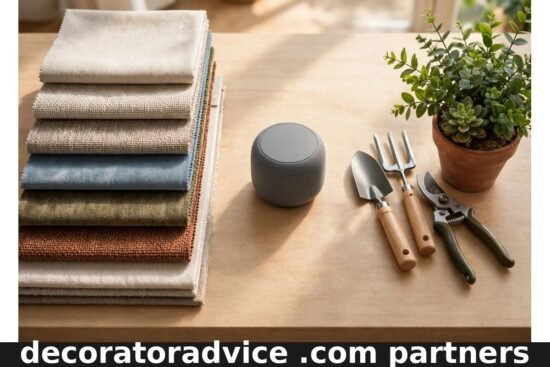
Day to day, the arrangement is simple. Each partner owns its topic outright: it decides what its readers need, researches its guides the same way the main site does — starting from a real homeowner question, checking the answer against current reports, working the numbers, and stating the limits — and publishes under its own name. Independence is deliberate: four sites repeating one article would help nobody.
What is shared is the infrastructure of trust. The calculator library — 43 free tools across seven categories, from construction and measurement to roofing, home systems and budget planning — belongs to the whole family, free to use with no sign-up. A DecoradYard reader working out topsoil quantities and a DecoradHouse reader costing a renovation are using the same library, held to the same standard of stated assumptions. Guides across the family link to the same tools, so the arithmetic a reader meets is consistent from site to site.
The other shared habit is the referral. When a reader’s project crosses a boundary — the kitchen renovation that becomes a garden project, the smart device question hiding inside a heating upgrade — the guide they are reading points them to the partner that owns the next topic rather than improvising outside its specialty.
What Is Partnership Not?
It is worth being blunt about this, because the word carries so much baggage elsewhere. Partnership here is not paid placement: no company pays to appear in a guide, a ranking or a recommendation. It is not pay-to-rank: the order of projects in the flagship guide comes from the disruption-day measure, and money cannot move a project up that list. It is not sponsored coverage dressed as advice, and it is not a lead-generation arrangement — the site is not a contractor marketplace, it is not a store, it takes no cut of any reader’s project, and it does not sell reader details to anyone.
Advice you can measure is only worth measuring if the conclusion was not bought first. The moment a partner could pay for a better verdict, every figure on every partner site would become suspect — the resale percentages, the disruption rankings, the calculator outputs. Keeping partnership as a publishing relationship between topic sites, and nothing more, is what keeps the numbers worth trusting. That refusal of paid influence is one part of the wider position set out on the site’s transparency page, which lists what the site never promises.
How Can a Prospective Partner Make Contact?
The family is small and topic-based, so partnership is not an open programme with tiers and packages. A site that publishes in a home topic the family does not yet cover, and that is willing to work to the standards on this page — named sources, stated assumptions, open corrections, no paid influence — can make contact through the site itself and say what it publishes and how. That conversation starts with the content: what the topic is, how figures are sourced, and whether the no-paid-placement rule can be kept without exception.
Most approaches will not fit, because most home sites are built on exactly the arrangements this family excludes — sponsored rankings, lead sales, or content written to move products. A prospective partner should expect its existing work to be read against the standards table above, and should expect the disruption-day yardstick and the correction policy to be the hardest parts to adopt. Sites that already publish that way are rare, and they are the only ones this conversation is really for.
What Are the Limits of Partnership?
Partnership improves how advice is produced; it does not make the advice infallible, and readers should know where its value stops. A partner’s guide still rests on national-level data and typical project descriptions. Your local labour rates, material prices and buyer demand can move the real answer a long way from the typical one, and no shared standard changes that. The figures are a well-checked starting point for your own measurements and quotes, never a substitute for them.
Partnership also does not certify anything outside the page. It does not vouch for a local contractor, a specific product on a shelf, or the condition of your home — none of which any partner site can inspect. Structural work, electrical work, gas and anything governed by local code still needs licensed professionals and, where required, permits, whoever published the guide you read.
Finally, the standards are enforced by review, not by magic. Partner content is checked when it is produced and revisited when new report editions appear, but between reviews, markets move and mistakes can survive longer than they should. The open-correction policy exists because the family expects to be caught out occasionally — and expects readers to hold every partner to the standard on this page.
Frequently Asked Questions
Who are the partners of smart decoratoradvice?
They are the topic sites in the same family: DecoradHouse for decorating, renovation and home exteriors; DecoradTech for smart home devices and setups; and DecoradYard for the garden, backyard and terrace. Each publishes in its own specialty under the family’s shared evidence standard.
Is partnership something a business can simply pay its way into?
No. Partnership is a publishing relationship between topic sites, not a paid programme. No company can pay for placement in a guide, a better position in a ranking, or a recommendation, and the site takes no cut of reader projects and sells no reader details.
Do the partner sites use the same calculators?
Yes. The library of 43 free calculators belongs to the whole family and works the same way on every site: free to use, no sign-up, with the assumptions and waste factors behind each estimate stated on the page so readers can judge the numbers for themselves.
What happens if a partner publishes a figure that turns out to be outdated?
The standard is open correction. When a newer edition of a source report appears, figures drawn from it are updated, and outdated numbers are called out rather than quietly repeated — the same policy the flagship guide applies to widely copied figures from older reports.
Does partnership mean the sites endorse local contractors or products?
No. Partnership covers how the family’s own content is researched and published; it certifies nothing outside the page. Choosing a contractor or a product still calls for local quotes, your own checks, and licensed professionals for regulated work.
Conclusion
decoratoradvice .com partners is, in the end, a short list with a strict rulebook: a small family of topic sites, each deep in its own subject, all of them measuring before they recommend and correcting themselves in public when the data moves. That arrangement — independence inside the topics, one standard across all of them — is what the word partners means here, and it is deliberately less glamorous and more useful than the paid version of the word elsewhere. For more home improvement advice you can measure, visit smart decoratoradvice.



3 comments