

A renovation trick earns its place by a saving you can measure — materials not bought, hours not paid for, waste not skipped — set against a caution counted honestly. The renovation tips and tricks decoradhouse here are held to that standard, each with its measurement and its limit.
Key Takeaways
- Judge every trick by its ledger: the saving it claims in money, materials or hours, set against its cost in effort, risk and finish quality.
- The largest savings are measurement savings — quantities calculated from the real room rather than rounded up at the merchant’s counter.
- Reuse and salvage pay when the saved item is sound and standard-sized, and quietly lose money when labour must fight an odd size or a tired material.
- Sequencing tricks save the second-largest sums: work ordered so nothing is bought twice, opened twice or finished twice.
- Keep a written list of tricks that failed in your project and why; the next renovation is where that list pays its dividend.
What Separates a Real Renovation Trick From a Costly One?
A trick is a trade, and the honest question is always what changes hands. The costly version of renovation advice sells the saving and hides the price: the bargain material that consumes three extra days of a paid trade’s time, the salvaged fitting whose non-standard threads turn a one-hour connection into an afternoon of adapters, the skipped preparation that returns as a finish failing inside its first year. The renovation tips and tricks decoradhouse in this article are admitted on the opposite evidence — each states the saving it claims, the measurement that would prove it, and the caution that travels with it, so you can judge the trade before you make it rather than after.
Time is the currency most tricks are secretly denominated in, and it must be counted at its real rate. An hour saved by a householder on a free Saturday is a genuine saving; an hour added to a professional’s day is a purchase, often at the highest hourly price in the whole project. This asymmetry explains why the same trick can be wisdom in a self-managed project and folly in a trade-managed one — laying your own reclaimed floorboards across a month of evenings may save a fortune, while asking a floor layer to work with them buys his slowest, most careful hours with your money.
Test a trick the way you would test anything else in a renovation: on the smallest scale that gives a true answer. One wall prepped the shortcut way, judged after the paint has cured and the lamps are on; one room’s materials ordered by the calculated method, compared against the waste pile at the end. A trick that survives a small honest test earns the whole project; a trick that fails small has failed at the cheapest possible price, which is the most a bad idea can ever offer you.
Which Measuring and Ordering Tricks Save the Most Money?
Overbuying is the quietest leak in a renovation budget, and it happens because quantities get rounded at every step: the room is measured generously, the merchant rounds the order up, a safety margin is added to a figure that already contained two. Measured properly, most rooms need markedly less than the rounded tradition buys — and the surplus is rarely returnable once it is cut, mixed or merely opened. The discipline is to calculate every quantity from the room’s real dimensions, in one sitting, before any order is placed, and to let the calculator carry the arithmetic while you carry the measuring tape.
Flooring shows the method at its clearest because its waste is visible in the skip. Measure the room wall to wall, including alcoves, then subtract nothing and guess nothing: run the figures through the Flooring Calculator, which returns the area and the pack count with the cutting allowance stated openly rather than smuggled into a rounded-up pile. Order the stated allowance and no more, keep one unopened pack in reserve against a damaged board, and agree the merchant’s returns terms for unopened packs before the delivery arrives — the trick is not buying less, it is buying exactly, with the surplus planned instead of accidental.
The same exactness pays in every material that is sold by coverage. Paint calculated from wall area minus real openings, tiles from the tiled area rather than the room’s, boards and battens from measured runs rather than from a wave at the ceiling — each calculation removes a small pile of surplus, and the piles add up to a room’s worth of material across a whole project. What the method asks in return is one honest measuring session per room, recorded in a notebook that travels to the merchant instead of a memory that improvises at the counter.
| Material | The rounded habit that overbuys | The measured method | Typical surplus avoided |
|---|---|---|---|
| Flooring packs | Round the room up, add a margin, round again | Real area through a calculator, allowance stated once | One to two packs per room, returnable if unopened |
| Paint | Buy for the whole room’s walls including openings | Wall area minus doors and windows actually present | A full tin on most rooms |
| Tiles | Order from room area, not tiled area | Measure only the surfaces being tiled, plus cutting allowance | Several boxes on a bathroom |
| Timber and battens | Buy long lengths and cut on site from memory | Measured runs listed per wall before ordering | A bundle of offcuts per project |
| Adhesive and grout | One extra bag per job, just in case | Coverage rates on the bag against the measured area | The extra bag, opened and wasted |
Which Reuse and Salvage Tricks Genuinely Pay?

Salvage pays when the item is sound, standard and expensive to buy new — and the test takes a minute per item. Solid internal doors, cast-iron radiators, sound timber joists and floorboards, and sanitary ware in genuinely good condition all pass it: each costs real money new, each fits standard openings and connections, and each can be inspected for its defects before a pound is committed. The saving is measured honestly as the new price minus the cost of stripping, repairing and refitting — and on the right items that arithmetic is not close.
The same honesty exposes the salvage that loses money while feeling virtuous. Odd-sized windows that demand bespoke surrounds, tired boilers whose efficiency taxes every future bill, warped doors that a carpenter must persuade rather than hang, and any electrical or gas appliance whose history cannot be proven — each transfers its apparent saving into labour, adapters and risk, usually exceeding the new price while delivering a worse result. The caution attached to every salvage decision is the labour question: who will make this fit, at what rate, in how many hours? A trick that cannot answer that question in numbers has not finished its own arithmetic.
Buy the new consumables even when the headline item is salvaged. New valves behind a reclaimed radiator, new seals in a kept window, new fixings throughout — the small new parts are what make an old item behave like a reliable one, and they cost a fraction of the saving they protect. Salvage also rewards timing: materials leave other people’s renovations constantly, and a project that knows its measurements in advance can say yes to the right door the week it appears, while a project measuring as it goes watches it leave on someone else’s truck.
Which Sequencing Tricks Stop You Paying Twice?
The most expensive sentence in renovation is “we will have to open that again,” and sequencing tricks exist to prevent it. Photograph and map every pipe, cable and joist before any surface closes — the map costs an evening and converts every future screw, fitting and repair from a gamble into a decision, and it makes the later trick of adding a shelf, a rail or a socket a ten-minute job instead of a detector hunt. The measurement attached to this trick is simply every future job in that room, each one made cheaper forever.
Order decisions in the sequence the work consumes them, and a surprising amount of money stops leaking. Tiles chosen before the bathroom is measured produce the wrong count in the prettiest possible pattern; a suite chosen after the pipe positions are fixed fits the room that exists. The general trick is to fix every dimension that other choices depend on — room measurements, pipe centres, waste positions, door swings — before spending on anything whose size those dimensions govern. Reversals of that order are where cutting, returning and compromising live.
Batch the wet and the messy across rooms wherever the plan allows it. A plasterer attending once for two rooms costs less than the same plasterer attending twice; a skip filled completely in one hire week costs less than two half-filled hires; paint bought for two rooms in one order reaches the honest quantity discounts that single rooms never see. The caution is coordination — batching only saves when the rooms are genuinely ready together — but where a project has several rooms at similar stages, aligning them is the closest thing renovation offers to free money.
| Trick | What it claims to save | The measurement that proves it | The caution that travels with it |
|---|---|---|---|
| Calculate every quantity from real measurements | Materials, across the whole project | Surplus in the skip at the end, counted against previous projects | One unopened reserve pack per material, or a damage stops the job |
| Salvage sound, standard-sized items | The new price of doors, radiators, timber | New price minus strip, repair and refit costs, in writing | Never salvage unproven gas or electrical items; budget the fitting labour |
| Photograph and map hidden work before closing | Every future fitting and repair in that room | Time taken by the next job that needs the wall | The map must be filed where it survives the project, not left in a phone |
| Fix governing dimensions before choosing finishes | Returns, cutting losses and compromises | Count of items returned or re-cut across the project | Governing dimensions must be final — a moved waste invalidates the chain |
| Batch trades, skips and orders across rooms | Call-out premiums and hire weeks | Invoice comparison against single-room scheduling | Only works when rooms are truly ready together; forced batching creates standing time |
Which Finish Tricks Protect Quality While Saving?
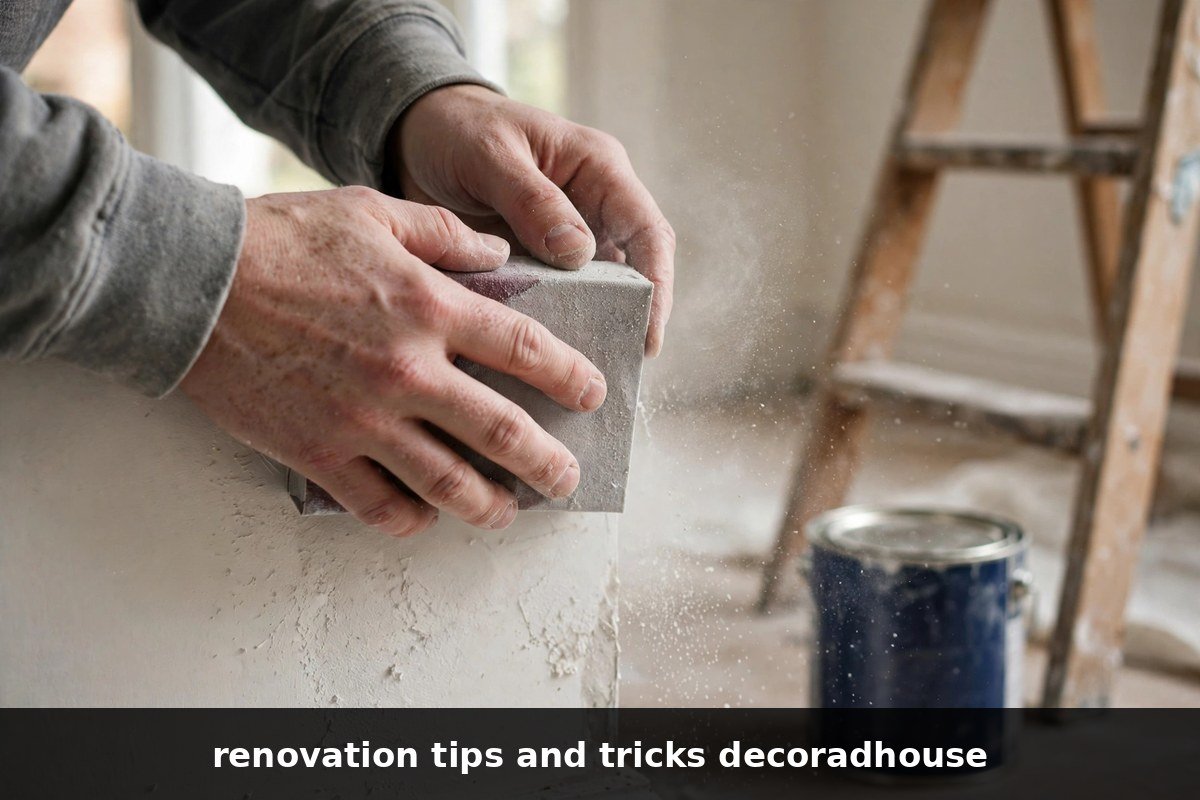
The finish is where tricks do their most dangerous work, because the finish is what the household will look at for a decade — so the tricks admitted here are the ones that save money by method rather than by omission. Preparing surfaces in bulk is the honest example: filling, sanding and washing every wall in a room in one session, before any paint is opened, costs less time than the stop-start alternative and produces the better finish as a by-product, because preparation done as a campaign is preparation that does not get skipped at the last wall. The saving is real and the quality rises with it, which is the signature of a genuine trick.
Spend on the touching points and economise on the seen-from-a-distance points, deliberately and in writing. Handles, taps, switches and the doors’ ironmongery are handled daily and judged by the hand, which detects cheapness instantly; skirting profiles, coving and the backs of fitted units are judged by an eye that cannot reach them. A budget that moves money from the second list to the first produces a room that feels expensive at the same total — the measurement is the hand’s verdict, repeated every day for years, against an invoice that did not change.
Keep every offcut, leftover and spare in labelled order until the project ends, and keep a few beyond it. The spare tiles from each room, stored flat with their batch noted, are the difference between a future cracked tile being a ten-minute repair and a whole-floor problem, because batches vary and yesterday’s dye lot cannot be bought tomorrow. Leftover paint with its colour and batch written on the tin turns touch-ups invisible. This trick saves nothing this month; it is on this list because across the life of the rooms it may save more than everything above it combined.
The Limits of Tricks in a Renovation
Every trick in this article has a floor beneath which it becomes false economy, and the floor is usually a licensed, warranted or structural matter. Saving money on gas, electrical or structural work by any route other than a qualified professional’s honest price is not a trick but a liability being installed in the walls. Similarly, tricks that economise on waterproofing, fire safety or ventilation are borrowing against failures that arrive with interest, in damage that dwarfs the saving by orders of magnitude. The ledger discipline that admits tricks also excludes these: their caution column reads “the house,” and no saving survives that entry.
Tricks also decay with scale in the opposite direction from most advice. A measurement trick that saves a fortune across a whole house saves little on a single cloakroom; a salvage hunt that pays across ten doors wastes a weekend for one. Match the effort of the trick to the size of the prize, and let small projects use only the tricks that arrive free — the photograph, the dimension list, the labelled leftovers — while the hunts and the batching belong to work large enough to feed them.
Finally, tricks refine a budget; they do not create one. A renovation whose honest total exceeds the money available will not be rescued by cleverness, because tricks move percentages, not totals — ten percent saved by excellent tricks is a triumph that still leaves a thirty-percent gap exactly where it was. The tricks in this article belong inside a sound plan, shaving its edges season by season and room by room. Used there, they compound. Used as a substitute for the plan, they merely decorate the shortfall.
Frequently Asked Questions
How much material should I really order beyond the measured quantity?
Order the calculated quantity plus the stated cutting and damage allowance for that material — and no second, silent allowance on top of it. Keep one unopened pack or tin in reserve, agree returns terms for unopened surplus before delivery, and record what was actually left over so the next room’s order is smarter. The overbuying this replaces came from rounding at every step; one honest allowance, stated once, is the whole trick.
How do you tell salvaged pieces worth reusing from pieces to leave behind?
Keep items that are sound, standard-sized and expensive new: solid doors, cast-iron radiators, sound structural timber and floorboards, and sanitary ware in verified good condition — always refitted with new valves, seals and fixings. Refuse odd sizes that demand bespoke making-good, worn boilers and any gas or electrical item whose history cannot be proven; their fitting labour and risk routinely exceed the new price they were meant to avoid.
Can tricks actually replace a contingency fund?
No — tricks reduce what a project wastes, while contingency pays for what a project discovers, and those are different ledgers. A hidden rotten joist is not cheaper because the flooring was measured exactly. Keep the contingency intact and let the tricks shrink the planned spend; a project that spends its contingency in advance on the strength of expected savings has simply renamed its risk.
What is the single most valuable trick in a whole renovation?
The pre-closing map: photographing and noting every pipe, cable and joist before surfaces cover them. It costs one evening, it cannot go wrong, and it pays out on every future job in the house — each shelf, socket and repair located by evidence instead of by detector and guesswork. Across the life of the rooms it outperforms flashier savings, because it is the only trick whose value grows every single year.
When does a money-saving trick become false economy?
When its caution column touches safety, structure or the hidden systems: gas, electrical and structural work, waterproofing, fire safety and ventilation. It also becomes false economy when its labour — yours at a professional’s rate, or a trade’s hours spent fighting an unsuitable material — exceeds the saving on paper. The test from this article applies: if the saving cannot be stated in numbers beside an honestly counted cost, the trick has not earned its place.
Conclusion
Judged by their ledgers rather than their cleverness, renovation tips and tricks decoradhouse come down to one discipline: measure before you buy, salvage only what is sound and standard, sequence so nothing is paid for twice, and write down every trick that failed you. A renovation run on those rules keeps its contingency for genuine surprises and its budget for the finishes the household will touch for a decade. For more home improvement advice you can measure, visit smart decoratoradvice.