A real garden hack is not a trick from a thirty-second video; it is a shortcut whose saving you can measure — minutes, litres or seasons — and whose cost you counted honestly. The garden hacks decoradhouse here are held to that standard, each with its measurement and caution.
Key Takeaways
- Judge every hack by its ledger: what it saves, in minutes, water or money, set against what it costs in effort, materials and risk to the plants.
- The best watering hacks slow water down at the root zone — buried bottles and drip tricks work because they imitate good plumbing, not because they are clever.
- Pest shortcuts that work are mostly physical: barriers, timing and habitat, because they remove the pest’s opportunity rather than declaring war on the pest.
- Compost and soil shortcuts succeed when they speed up what nature already does — chopping, layering and covering — and fail when they promise to skip the biology.
- Keep a short list of hacks that failed in your garden and why; a tested failure is worth more than a hundred untested tips.
What Separates a Real Garden Hack From a Viral One?
A hack is a trade, and the honest question is always what changes hands. The viral version of gardening advice sells the saving and hides the cost: the spray that costs nothing to make and quietly costs a plant its leaves, the shortcut that saves ten minutes in spring and spends two hours in August putting the damage right. The garden hacks decoradhouse in this article are admitted on the opposite evidence — each one states the saving it claims, the measurement that would prove it, and the condition under which it stops working, so you can test it in your own beds before trusting it with the whole garden.
The test bed is the hacker’s best friend and takes five minutes to set up. Try any new shortcut on one plant, one row or one corner first, beside an untreated neighbour growing in the same soil and light, and look at the pair again in a fortnight. A hack that cannot show a difference in a side-by-side test was not saving anything you can identify, and a hack that shows a difference in the wrong direction has taught you something cheaply. Gardeners who test this way build, within a few seasons, a short personal list of shortcuts that genuinely work in their soil and climate — a document worth more than any listicle, including this one.
Effort belongs in the ledger beside money and water. Several famous shortcuts save a small purchase and cost a large chore — sieving homemade compost for an hour to save a bag’s worth of bought material may be pleasure or may be theft from your own weekend, depending on how you count. Count honestly: a hack earns its keep when the total of what it saves, across the whole season and including your time, clearly outweighs the total of what it costs, and it deserves to be dropped the season that arithmetic turns against it.
Which Watering Hacks Actually Save Time or Water?
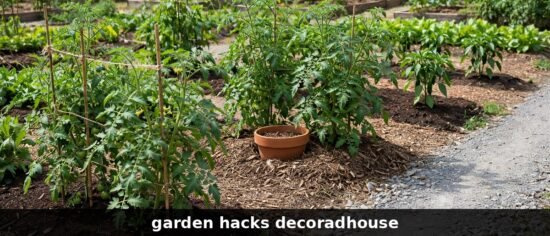
The watering hacks that work all do the same unglamorous thing: they deliver water slowly, at the roots, with less of it lost to the air and the surface. A plastic bottle with pinholes in its cap, buried neck-down beside a thirsty plant and refilled as it empties, is simply a homemade drip emitter — crude, nearly free, and effective for exactly the reason a manufactured drip line is effective, because the water enters the soil at the pace the soil can accept. Unglazed terracotta pots buried to their rims and filled with water work on the same principle through their porous walls, seeping steadily into the root zone of whatever is planted around them.
Measure the saving rather than admiring the ingenuity. Water one plant by can and its neighbour by buried bottle for a fortnight, keeping a rough count of litres and minutes for each, and the ledger will tell you whether the hack suits your garden’s size: on a balcony of six pots it is a triumph, while across forty plants the refilling rounds can quietly cost more time than the hose ever did. The honest scale limit of most watering hacks is the garden itself — they serve containers, new plantings and high-value thirsty crops beautifully, and they collapse as a system for whole beds, where real plumbing remains the correct answer.
Mulch is the watering hack hiding in plain sight, and its measurement is the simplest of all: a bare bed and a mulched bed, watered equally, checked with a finger a day later, in any dry week of summer. The covered soil stays moist measurably longer, because the layer shades the surface, breaks the wind’s access and stops the crust that sheds water sideways. If your beds are not yet mulched, no bottle trick in this article will save you as much water as that single layer will — hacks are for refining a system, not for replacing its biggest component.
Which Pest Shortcuts Work Without Poisoning the Garden?
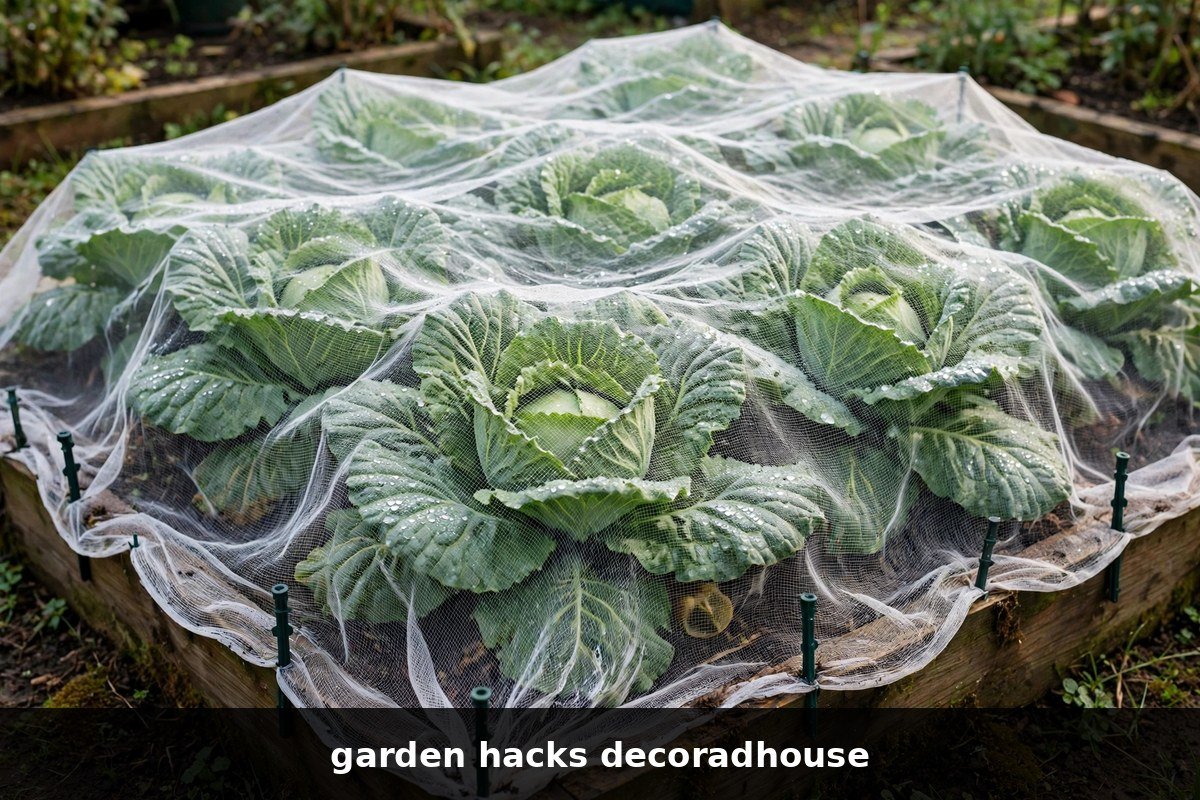
The pest shortcuts with the longest track records are physical, because they subtract an opportunity instead of adding a chemical. A collar of cut bottle or cardboard around a seedling’s stem defeats the cutworm that fells transplants at soil level; a fine mesh thrown over brassicas the day they are planted excludes the butterflies whose caterpillars would otherwise be picked off leaf by leaf all summer; a board laid on damp soil overnight collects the slugs sheltering beneath it by morning, converting a night of damage into a thirty-second inspection. Each of these is measurable in the plainest currency: plants standing that would have fallen, leaves whole that would have been lace.
Timing is a shortcut that costs nothing at all. Watering in the morning rather than the evening leaves foliage dry through the night hours when fungal diseases spread best and when slugs do their longest feeding; spacing plants for airflow rather than crowding them for effect dries leaves faster after every rain; and clearing fallen fruit and spent foliage removes the winter housing of pests and spores that would otherwise open next season at full strength. None of these will ever trend, because none can be photographed doing anything — which is precisely why they work unnoticed for decades.
Treat the famous kitchen sprays with the suspicion their evidence deserves. Mixtures of soap, oil, chilli or garlic are routinely recommended as harmless deterrents, and some do shift some pests for some days, but soap solutions cannot distinguish a pest from a leaf’s own protective coating, and a spray strong enough to trouble an aphid colony is frequently strong enough to scorch the foliage it was meant to defend — in sun, on soft growth, the damage can exceed the pest’s. If you test one, test it as this article tests everything: on one plant, in shade, diluted as directed, judged after a week. A hack whose caution is longer than its method is usually telling you something.
| Hack | What it claims to save | The measurement that proves it | The caution that travels with it |
|---|---|---|---|
| Pinhole bottle buried beside a plant | Water and daily watering rounds | Litres and minutes logged against a can-watered neighbour for a fortnight | Suits pots and new plantings; refilling forty bottles eats the saving |
| Terracotta pot buried and filled | Slow, deep delivery to roots | Soil moisture a finger’s depth down, beside an unassisted plant after two dry days | Pots crack in hard frost if left full and buried over winter |
| Mesh over brassicas from planting day | A summer of caterpillar picking | Whole leaves at month’s end versus an uncovered plant nearby | Mesh must be sealed at the edges and lifted for weeding, then replaced |
| Board on damp soil overnight | Slug damage without pellets | Slugs collected per morning against damage on unprotected rows | Only collects; the collected slugs still need a destination |
| Kitchen sprays for aphids | Bought insecticide and its cost | One test plant, in shade, judged after a week for pests and for scorch | Soap mixtures can strip leaf coatings and burn soft growth in sun |
How Can Compost and Soil Shortcuts Speed Up Feeding?
Compost shortcuts work when they accelerate the biology and fail when they attempt to replace it. Chopping material finely before it enters the heap is the genuine article: smaller pieces present more surface to the organisms doing the work, so a minute with shears over a bucket of prunings honestly buys weeks at the finished end of the process. Layering green and brown material as you go, rather than in occasional avalanches of one kind, keeps the heap’s appetite balanced without any turning at all — the famous no-dig heap is not a miracle, merely a pile whose ingredients arrived in the right proportions slowly.
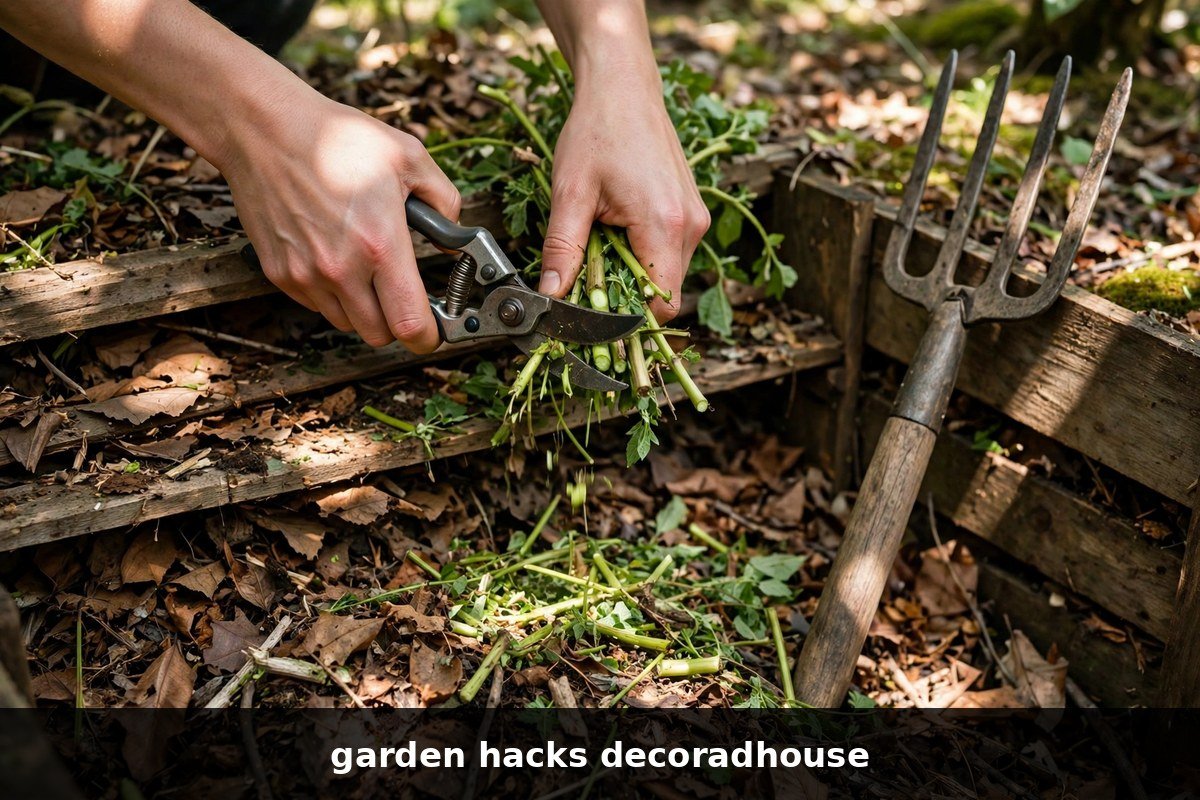
Chop-and-drop is the bed’s version of the same idea and the laziest sound hack in this article. Spent foliage, pulled weeds that have not yet set seed, and the trimmings of vigorous ground-cover plants are simply cut and dropped where they grew, to rot down as a surface mulch that feeds the soil in place. The saving is real and measurable — no barrow journeys, no heap management, nutrients returned to the exact bed that produced them — and the caution is equally real: anything carrying seed or disease must be excluded, because a shortcut that replants your weeds and reinoculates your beds has the arithmetic exactly backwards.
Leaf mould is the patient gardener’s shortcut, which is to say it trades time you do not spend for time the leaves do. Autumn leaves bagged or binned loosely, moistened and left alone, become in a year or two a crumbly soil conditioner that seed composts and potting mixes envy — with almost no labour beyond the gathering, which the paths needed anyway. The measurement is patience itself, and the caution is species: a few leaves, walnut most famously, carry compounds many plants dislike, and evergreen leaves rot so slowly that they belong in the general heap rather than the leaf mould bin.
Which Layout and Tool Hacks Save Steps Every Week?
Some hacks save nothing once and something every week, and those compound the fastest. Lay one firm route through the part of the garden you cross daily — gravel spread over a woven membrane, its tonnage worked out from the route’s own measurements with the Gravel Calculator before a single bag is ordered — and the mud season’s tax on every journey ends: no boards to balance on, no barrow ruts in wet lawn, no mud carried into the house on boots a dozen times a day. The measurement is not really the gravel; it is every dry-footed trip from November to March, multiplied by every year the path outlasts your memory of laying it.
Tool placement is a hack disguised as tidiness. A small weatherproof box or a bucket stationed where the work actually happens — twine, snips, gloves, plant ties, a hand fork — saves the walk back to the shed that interrupts more garden jobs than weather does, and a long-handled tool hung at the bed’s end rather than stored across the garden will be used for the five-minute job that the shed version gets postponed past doing. Count the journeys for a week before and after moving the tools; gardeners who do this once tend to become evangelists, because the saving is absurdly large relative to the effort of a hook and a box.
Labels deserve their thirty seconds of seriousness, because the cheapest information system in the garden is the one that survives winter. A pencil-written label fades, a marker washes, and the spring guessing game over unmarked rows and anonymous perennials costs real plants every year — dug up as weeds, fed as something else, divided in the wrong month. Stamped, engraved or paint-penned markers, written at planting rather than promised for later, are the unglamorous hack underneath half the routines in gardening: every other shortcut in this article works better in a garden whose plants you can still identify in February.
The Limits of Hacking a Garden
Every hack in this article has a scale at which it stops working, and the honest gardener’s skill is noticing the season it happens. Bottles that served six pots become a second job at sixty plants; chop-and-drop that feeds a small bed spreads weed seed through a large one if discipline slips for a single month; a no-turn heap that balanced itself at one family’s scale can go cold and sour at another’s. Hacks are tuned to a garden’s size, soil and keeper, which is why the test-bed rule outranks every individual tip here: your own fortnight’s comparison is worth more than any general claim, including the ones in this article.
Some famous shortcuts fail their ledger outright and are worth naming as warnings. Weedkilling sprays of vinegar or salt, endlessly shared, do burn foliage on contact — and then salt the soil itself, in the case of salt quite literally, damaging the ground’s future planting for the sake of this week’s weeds. Thick layers of uncomposted manure or fresh wood chip dug into beds can rob nitrogen as they rot and stall the very plants they were meant to feed. A hack that spends the soil to save the gardener has the trade precisely inverted, since soil is the one asset in the garden that compounds.
| Famous shortcut | What it promises | Why it fails its ledger |
|---|---|---|
| Vinegar or salt sprayed on weeds | Free weedkiller from the kitchen | Burns foliage on contact, then damages the soil itself — salt especially — taxing future planting |
| Fresh wood chip dug straight into beds | Instant mulch and feed in one | The chips rob nitrogen from the soil as they rot, stalling the plants they were meant to feed |
| Coffee grounds tipped on every bed | Free fertiliser with every pot | Thin surface use is harmless, but thick layers compact, repel water and feed nothing measurably |
| Beer traps for slugs, set and forgotten | Pest control while you sleep | They attract slugs from further away than they drown, and a neglected trap becomes a breeding shelter |
Finally, hacks refine a system; they do not replace one. A garden without mapped sun, known soil and planned water will defeat its owner’s cleverest shortcuts within a season, because the failures will be foundational rather than incidental. Build the base once, keep the seasonal routine running, and then let hacks do what they are genuinely good at — shaving minutes, litres and small costs off a system that already works.
Frequently Asked Questions
How can I tell whether a garden hack really works?
Run it as a test rather than adopting it as a belief: apply the hack to one plant, row or corner, leave an identical untreated neighbour beside it in the same soil and light, and compare the pair after a fortnight with the saving actually counted — litres poured, minutes spent, leaves damaged or saved. A hack that shows no measurable difference was saving nothing identifiable, and one that shows damage has taught you its lesson at the cheapest possible price.
Do buried bottle drippers really water plants properly?
Yes, at their proper scale, because they work by the same principle as manufactured drip irrigation: water released slowly at the root zone, at a pace the soil can absorb, with little lost to wind or surface evaporation. Their limit is arithmetic rather than effectiveness — refilling bottles for a few pots or new plantings takes moments, while the same routine across dozens of plants can cost more time than the hose it replaced, which is why whole beds still belong to planned watering.
Are homemade soap sprays safe for aphids?
Not reliably, and the caution matters more than the recipe. Soap solutions can shift aphids, but they can also strip a leaf’s protective coating and scorch soft growth — especially when sprayed in sun — sometimes damaging the plant more than the infestation would have. If you try one at all, dilute it as directed, spray a single test plant in shade, and judge after a week; barrier methods, water jets and tolerating the predators that arrive to eat aphids are all gentler first answers.
What is the fastest honest way to improve soil without buying compost?
Chop-and-drop on the beds themselves: cut spent foliage and seedless weeds where they grew and leave them as a surface layer to rot in place, returning their nutrients to the exact soil that produced them, while a leaf-mould bin of autumn leaves quietly matures into next year’s conditioner. Both methods speed up what soil organisms already do rather than pretending to replace them, and both fail only when diseased material or weed seed is allowed into the layer.
Which single hack saves the most time across a whole season?
For most working gardens it is the boring one: tools and materials stationed where the work happens instead of across the garden in the shed. A box of twine, snips, ties and gloves at the bed’s end abolishes the interrupted-job walk that quietly eats more gardening time than any pest, and unlike most hacks its saving grows with the garden, because every bed added inherits the same short walk.
Conclusion
Judged by their ledgers rather than their novelty, garden hacks decoradhouse come down to a discipline you can apply to any tip you ever meet: demand the saving in numbers, run the fortnight’s test beside an untreated neighbour, and keep the caution attached to the method wherever you write it down. A short list of shortcuts proven in your own soil will outperform a feed full of other people’s miracles, every season you garden. For more home improvement advice you can measure, visit smart decoratoradvice.