

The cheapest exterior work is the small recurring kind: cleared gutters, caught paint, sealed joints and tended paths, done on a rhythm before weather turns neglect into damage. The home exterior hacks decoradhouse collects here are maintenance hacks — each small, measured, and aimed squarely at prevention rather than appearance.
Key Takeaways
- A maintenance hack is judged by what it prevents, not by what it improves: its success is the repair that never has to happen.
- Water is the enemy in almost every exterior failure, so most hacks here are really about where water goes, sits or gets in.
- Timing is the technique: a gutter cleared before the storm season and a paint blister caught in spring are worth ten of the same jobs done late.
- Every hack carries its measurement — gutter fall, crack width, seal gap — because prevention done at the wrong size is decoration.
- Maintenance maintains sound fabric only; movement cracks, rotten timber and anything at roof height beyond safe reach belong to professionals.
What Makes a Maintenance Hack Different from a Repair?
A repair answers damage that has already happened; a maintenance hack is the small job, done on a rhythm, that makes the damage unnecessary. The distinction is not size but timing and intent. Clearing a gutter is a hack; replacing the fascia it rotted is a repair, and the two jobs differ by a season of neglect and several hundred in cost. The home exterior hacks decoradhouse gathers below are therefore organised by what they prevent — damp walls, peeling systems, frost-split surfaces, failed seals — rather than by how they look when finished, because a maintenance hack that shows is usually one that came too late to be one.
Water writes most of the script. Rain is meant to be collected, moved and discharged by the house’s exterior systems, and nearly every expensive exterior failure — stained render, blown paint, rotted joinery, spalled brick, heaved path slabs — is a story of water spending time somewhere it was only meant to pass through. So the maintenance eye learns to read a facade as plumbing first and paint second: where does the water land, where does it run, where is it standing that it should not be.
The rhythm matters as much as the jobs. Maintenance hacks cluster at the season turns — before the rains, before the frosts — because that is when their prevention is purchased cheapest. A household that walks its exterior twice a year with a notebook will catch nearly everything in these sections while it is still a hack; a household that waits for symptoms will meet the same list again later, wearing repair prices.
Which Gutter Hacks Stop the Expensive Damage?
The gutter’s one job is to move roof water to a downpipe faster than it can overflow, and its hacks defend that job on three fronts: blockage, fall and joints. Blockage is the famous one — leaves, moss and roof grit collecting until the gutter is a hanging garden that spills at every rain — and the hack is a clearing rhythm matched to the trees over the roof rather than to a calendar date: a house under a shedding tree may need three clearings a year, a house in the open may need one. What matters is that the clearing happens before the season of heavy rain, while the gutter is still a channel and not yet a dam.
Fall is the quiet one. A gutter should slope gently and continuously toward its downpipe — roughly a few millimetres of fall per metre of run — and a run that sags at a bracket ponds water, which silts, which grows, which overflows at exactly the stained patch on the wall below. The check costs a hose and five minutes: run water at the far end and watch whether any of it is still sitting in the gutter a minute after the flow stops. Water still sitting in the run a minute later means a bracket has let the run sag — lift it back to the line, because ponding left alone is a standing order for silt, weeds and overflow.
Joints and sizing complete the section. Drips at joints are seals at the end of their life — clean, dry and reseal in a dry spell rather than wipe and hope. And when a gutter chronically overflows in storms despite being clear and true, suspect its size rather than its condition: run the roof’s length and the rainfall it must handle through the Gutter Calculator and compare the answer with what is hanging there, because an undersized gutter on an enlarged or re-roofed house will overflow innocently forever. The caution that governs the whole section is access: gutters live at ladder height, ladders demand level ground, a second person footing them, and a hard rule against leaning out — a hack that ends in a fall has prevented nothing. Gutters guard the scheme as well as the structure — the zones they protect are laid out in the whole-facade system, where the roofline’s part in the design is set.
| Season | The hack, done then | What it prevents |
|---|---|---|
| Early spring | Walk the exterior with a notebook; list every blister, gap and stain while they are small | The whole year’s repairs, caught while they are still hacks |
| Late spring, dry spell | Touch up caught paint; reseal failed joints and perimeter seals | Summer rain entering at the gaps winter opened |
| Autumn, after leaf fall | Clear gutters and downpipes; check gutter fall with a hose | Winter overflow, saturated walls and the damp that follows |
| Before first frost | Seal driveway and path cracks; lift and re-bed rocking slabs | Frost wedging small cracks into broken surfaces |
| After storms, any season | Check for slipped panels, lifted felt edges, new stains under gutters | Small storm damage becoming next season’s rot |
How Do Touch-Ups Protect the Paint System?
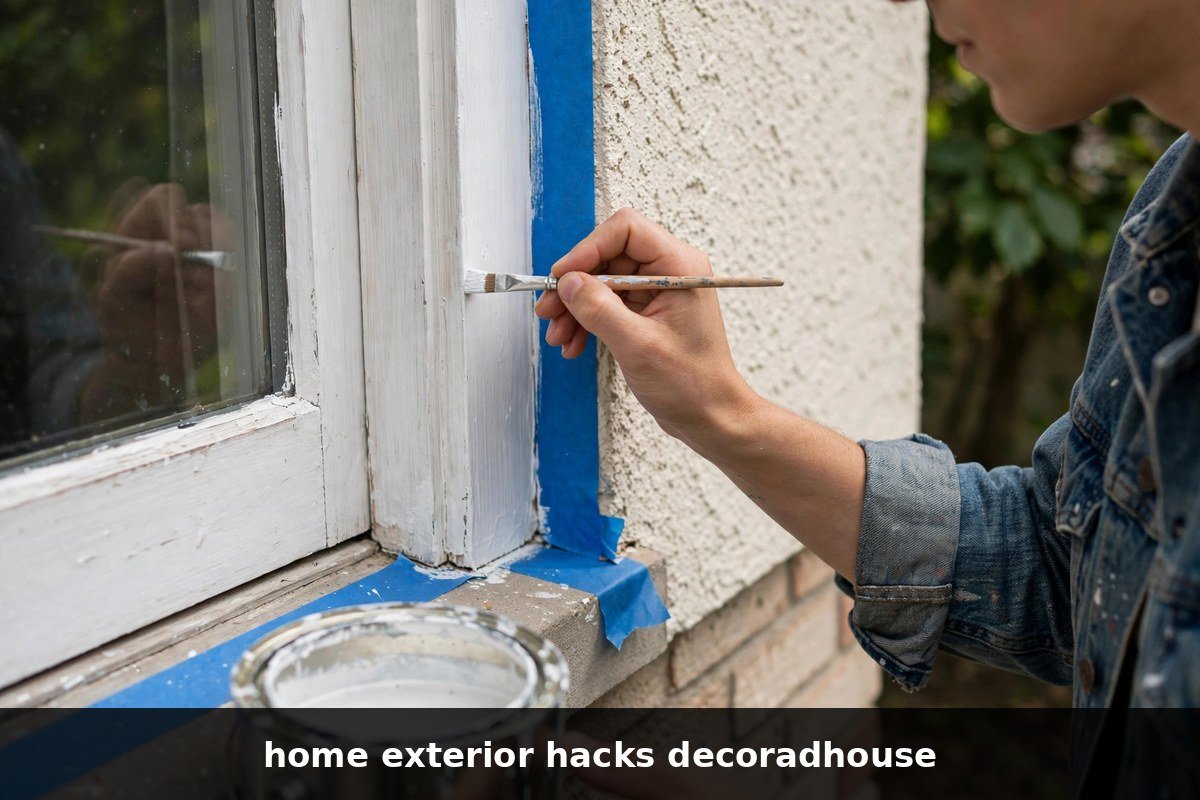
Exterior paint is a system — preparation, primer, coats — whose protection fails at its first break, and touch-ups are the hacks that keep the break from spreading. The enemy sequence is always the same: a blister or crack opens, water enters behind the film, the film lifts further, the timber or render beneath stays wet, and a patch becomes a strip-and-repaint. Caught at the blister, the job is twenty minutes: scrape what is loose and only what is loose, sand the edge to a feather, spot-prime the bare material, and finish with the same paint the system was built with — which is why the wisest maintenance purchase in the house is a labelled, sealed leftover tin from every exterior job, kept against exactly this day.
Two cautions separate a touch-up from a disguise. Never paint over damp, algae or rot: paint seals in the condition it covers, and a beautiful film over wet timber is a preservative for decay. And a blister that returns in the same place is a message, not a nuisance — moisture is arriving from behind or within, and the maintenance answer is to find its route, not to renew the paint over its exit. Where the failing patch is large, or the system’s coats are unknown layers of old work, the honest hack is to test a small area first, because incompatible paints announce themselves by wrinkling, and a test patch is cheaper than a whole wall’s discovery.
What Do Driveway and Path Hacks Prevent?
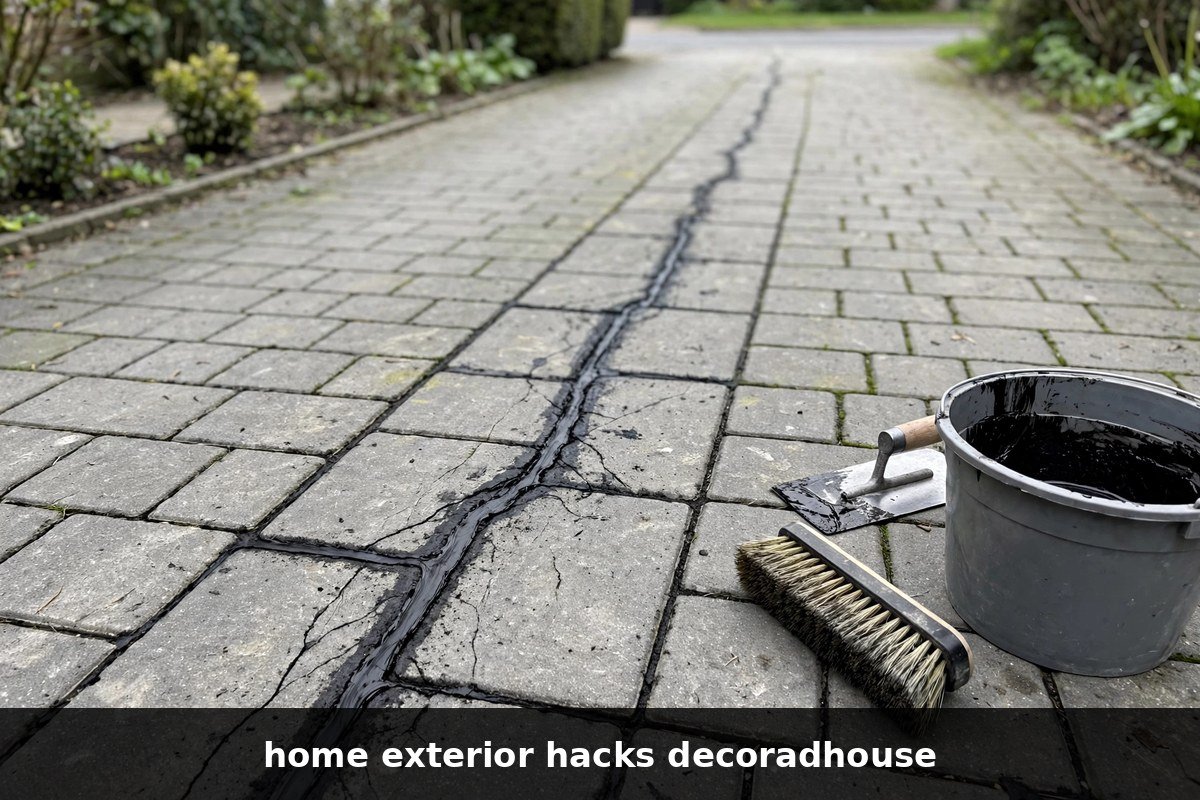
Hard surfaces fail by water and movement, and their hacks are sealing and seating. Cracks are the priority, because a crack is a wedge waiting for winter: water enters, freezes, expands, and returns in spring having widened its accommodation, year on year, until the surface breaks up along the line. The hack is to fill cracks while they are still hairlines — cleaned out, dried, and filled with the flexible filler made for the surface — and its measurement is simple: any crack wide enough to accept the edge of a coin is wide enough to accept water in quantity, and should not see a frost unfilled.
Biological growth is the second front. Moss and algae hold moisture against surfaces, make paths treacherous, and work roots into joints; the maintenance rhythm is a stiff brush and a treatment in the dry season rather than a heroic pressure-wash in the wet, with one caution the advertisements omit: pressure washing at close range erodes the surface it cleans, blasts the jointing out of block paving, and can drive water where it would never have reached — it is a tool with a minimum distance, not a magic wand. Rocking slabs, finally, are re-bedded singly and early, for the same reason given to the path in any season: a slab that moves pumps water beneath itself with every step and will take its neighbours down in a row if it is left to teach them. The path is also the visitor’s first read of the house, and its same-day improvements are gathered in entry-zone fixes for one day.
Where Do Seals and Caulk Quietly Save the House?
The perimeter seals — around window and door frames, at the junctions between materials, along the expansion joints in hard surfaces — are the exterior’s least visible system and its most per-pound valuable. Sealant has a working life measured in years, not decades, and its failure mode is quiet: it hardens, shrinks, and parts from one side of the joint, leaving a slot that admits driven rain precisely where two materials meet and neither can dry. The hack is inspection with a fingernail: sound sealant gives slightly and holds both edges; failed sealant is rigid, cracked or hanging from one side, and it is replaced by cutting out the old, masking the joint’s edges, and tooling the new bead smooth in one pass.
| Hack | The measurement or check | The caution that keeps it a hack |
|---|---|---|
| Gutter fall check | A hose run; water still standing a minute later means a sagging bracket | Ladder on level ground, footed by a second person; never lean out |
| Paint touch-up | Blister caught while the surrounding film is still sound | Never over damp or rot; a returning blister means moisture has a route |
| Crack sealing | Any crack that takes a coin’s edge takes water, and should not see frost | Flexible filler for the surface; rigid fills crack out again |
| Perimeter resealing | Fingernail test — sound seal gives slightly and holds both edges | Cut the old seal out fully; new over old fails with the old |
| Slab re-bedding | Rock underfoot is movement, and movement pumps water | One slab early is a hack; a moving row is a rebuild |
The expansion joints in drives and paths deserve their own sentence, because they are seals by another name: the soft joint between slabs exists to absorb movement, and when its filler dies the joint becomes the crack the frost was waiting for. Renewing it is unglamorous, quick, and — like everything in this article — invisible when it works, which is the whole aesthetic of maintenance: the well-kept house does not look maintained, it simply never looks damaged.
The Limits of Maintenance Hacks
Maintenance maintains; it does not resurrect or diagnose. A crack that widens between inspections, steps diagonally across brickwork, or reopens along the same line after filling is movement, and movement is a surveyor’s question, not a filler gun’s. Timber that a screwdriver enters without resistance is rot past the reach of touch-ups, and a gutter problem that turns out to be a roof problem — slipped tiles, failed flashing, a valley leaking — is above both the hack’s pay grade and, usually, its ladder.
Height draws the hardest line. These hacks assume safe reach from the ground or a properly footed ladder at gutter height; anything requiring work on the roof itself, at a chimney, or beyond a conservatory’s fragile span is professional territory, and no prevented damp patch has ever been worth a fall. Similarly, the hacks stop at the services: a stained ceiling below a bathroom is plumbing until proven otherwise, and sealant is not a plumber.
Finally, maintenance has a record-keeping limit: hacks done from memory drift. The spring notebook — what was caught, what was touched, what was deferred and why — is the difference between a rhythm and a series of surprises, because last year’s deferred item is this year’s first inspection, written down while it was still cheap.
Frequently Asked Questions
How often should gutters actually be cleared?
As often as the roof’s surroundings demand, which the gutters themselves will tell you: check them after leaf fall and before the heaviest rain season, and clear whenever debris is visible from the ground or overflow appears in rain. A house under trees may honestly need three clearings a year; a house in open ground may need one. The wrong interval is the one chosen by the calendar while a shedding tree stands over the roof — the tree sets the schedule, the calendar only reminds.
Can I touch up a small patch without priming?
On previously painted, sound material where only the topcoat has failed, a light sand and the same finish can suffice. On anything bare — timber, render, metal exposed by the failure — no: an unprimed patch is a future blister with a date on it, because the finish coat cannot grip or protect raw material the way the system’s primer was designed to. The primer is the patch’s foundation; skipping it saves four minutes and spends the repair.
Why do small driveway cracks matter so much?
Because winter works on them with leverage no other season has. Water sitting in a hairline crack expands as it freezes, and ice does not ask the surface’s permission; each freeze-thaw cycle returns the crack slightly wider, admitting more water, until a hairline becomes a split and a split becomes a broken edge. Sealed at hairline width, the same crack admits nothing and stays a hairline for years — the entire economics of this article in one joint.
How do I know a perimeter seal has failed?
Test it with a fingernail and your eyes together: sound sealant feels slightly resilient, sits unbroken, and holds both sides of its joint. Failure shows as hardening, cracks across the bead, shrinkage away from one edge, or a bead that lifts when pressed — and its signature indoors is a damp patch or draught at exactly the joint’s line after driven rain. Any of those signs means replacement, not a smear of new over old, which fails on the old seal’s schedule.
When is an exterior crack not a hack job?
When it moves. A crack that is wider at one inspection than the last, that steps diagonally through brickwork rather than following a joint, that mirrors inside the house, or that reopens after honest filling is reporting structural movement, and its correct next step is a surveyor’s or structural engineer’s reading — not another tube of filler. Filling a moving crack does not merely waste the filler; it erases the evidence the professional needs to read.
Conclusion
Kept on their rhythm, home exterior hacks decoradhouse are less a list of jobs than a way of walking around a house: reading it as plumbing first, catching each small failure in the season when it is still cheap, and writing down what was deferred before it can become a surprise. The reward is deliberately invisible — a facade that never quite needs rescuing — which is why maintenance is the most underpraised skill in home ownership and the one that quietly funds all the others. For more maintenance guidance you can schedule rather than dread, see smart decoratoradvice.