
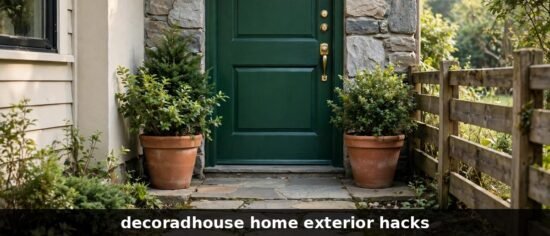
The approach to a house — door, porch, path, gate and the light beside them — can be transformed in one day with measured jobs rather than a renovation. The decoradhouse home exterior hacks here stay inside that day: each sized by a measurement first and finished before dark.
Key Takeaways
- An entry-zone hack is small, reversible and finished in a day: it changes the arrival, not the structure of the house.
- Measure before buying at every step — the door’s furniture positions, the mat’s true size, the fence run, the number height — because entry pieces are unforgiving of guessed sizes.
- Work in daylight order: paint first so it can cure, the gate and fence while the light is good, numbers and lighting last so they can be judged at dusk.
- The gate is the hack with a tool behind it: count panels and posts from the measured run, not from a look down the boundary.
- Know the boundary of the genre: hacks polish an approach that already works; they cannot repair damp, failing render or a rotten fence post.
What Counts as an Entry-Zone Hack — and What Does Not?
An entry-zone hack is defined by three qualities: it sits on the approach to the house rather than its structure, it can be completed between breakfast and dusk by one person with ordinary tools, and it can be undone without a skip if taste changes. Painting the front door qualifies. So do new door furniture, a correctly sized mat, a realigned gate, a planted porch pot, legible house numbers and a light that makes the keyhole findable. Each is small; together they are the difference between a house that is arrived at and a house that merely has an address.
The exclusions matter as much as the inclusions, because the entry zone is where small jobs love to impersonate big ones. Repointing, render repair, fence-post replacement and any work on the path’s levels are maintenance or renovation, not hacks, and they belong to a different day and a different budget. The decoradhouse home exterior hacks in this article hold the line deliberately: everything here assumes the underlying approach is sound — the path does not pond, the gate post stands firm, the door closes true — and spends the day on the layer a visitor actually meets.
Cost honesty belongs in the definition too. A hack day is cheap because its materials are small: a tin of exterior paint, a handle set, a coir mat, hinges, screws, a light fitting, numerals. The moment a hack requires hired plant, a second pair of professional hands or a delivery lorry, it has left the genre — which is a useful test to apply at the shop, because it keeps the day a day. The entry is one zone of a larger whole, and the whole-facade system by zone is where its colours and materials take their orders from.
Which Front Door Hacks Pay Off the Same Day?
The door is the entry zone’s headline, and its biggest hack is paint — with the preparation counted honestly inside the job. A sound door needs a wash, a light sand to key the surface, masking at the glass and edges, and two coats with the manufacturer’s drying gap between them; a door whose paint is flaking to bare wood needs the loose material off and the bare patches primed, which is still a day’s work but a longer one. Measure the door before ordering anything that touches it: its height and width for the weatherstrip that seals its edges, and the positions of the existing handle, letterbox and knob holes, because new furniture that misses the old holes turns a hack into a joinery repair.
Hardware is the second hack, and it works because hands judge a door before eyes do. A handle that closes with a clean click, a knocker with weight, a letterbox that does not rattle in wind — these register as quality at exactly the moment a visitor is standing still with nothing to look at but the door. Match the finish across every piece; three metals on one door read as three separate accidents.
| Entry hack | What it changes for a visitor | Time it honestly takes | Measurement to take before buying |
|---|---|---|---|
| Door repaint, sound surface | The whole first impression; the house looks kept | Most of the day, in two coats with drying between | Door size for paint coverage; note glass and edges to mask |
| New door furniture set | The feel of arrival — weight, click, no rattle | An hour or two, holes permitting | Backset and the positions of every existing hole |
| Weatherstrip and draught seal | A door that closes snug; less whistle, less rattle | Under an hour | The gap around the closed door, checked at several points |
| Correctly sized mat and boot brush | A threshold that works in wet weather | Minutes | The recess or step width the mat must actually fill |
The last door hack is the seal, and it is the one with a return beyond appearance: a door that meets its frame all round keeps the hall warmer and the weather outside, and the check takes a minute with a strip of paper — closed in the door at points around the frame, it should resist being pulled out at every one. Where the paper slides freely, the seal is missing its meeting, and that gap is the hack’s true address.
How Do Porch and Path Hacks Change the Arrival?
The porch and path are the entry zone’s supporting act, and their hacks are about footing and framing rather than decoration. A path that is swept, edged and clear reads as intention; the same path with creeping grass at its joints and a hedge swallowing its width reads as backlog. Edge the path with a spade cut or a trimmer line so its shape is visible, because a defined edge is the cheapest geometry in gardening. Where slabs rock, lift, re-bed and re-point the offender rather than the row — the hack scale is the single slab, and a path of twenty sound slabs and one rocking one is a one-slab job.
Planting at the porch works when it frames the door rather than competing with it: a matched pair of pots or planters either side, sized to the porch rather than to the shop display, with plants whose mature width will not swallow the step in a season. Measure the step’s depth before choosing the pots; a planter that leaves a visitor squeezing sideways past a shrub has framed the door with an obstacle. Evergreen structure with seasonal colour swapped in is the low-effort pattern — the frame stays, the flowers rotate.
The mat deserves its sentence because it is the entry’s hardest-working object: sized to the full width of the door swing’s landing, thick enough to scrape, and — in a recess — cut to the recess rather than curling at its edges. A mat that fits is a hack; a mat that nearly fits is a trip with a pattern on it.
What Can One Day Do for the Fence and Gate?
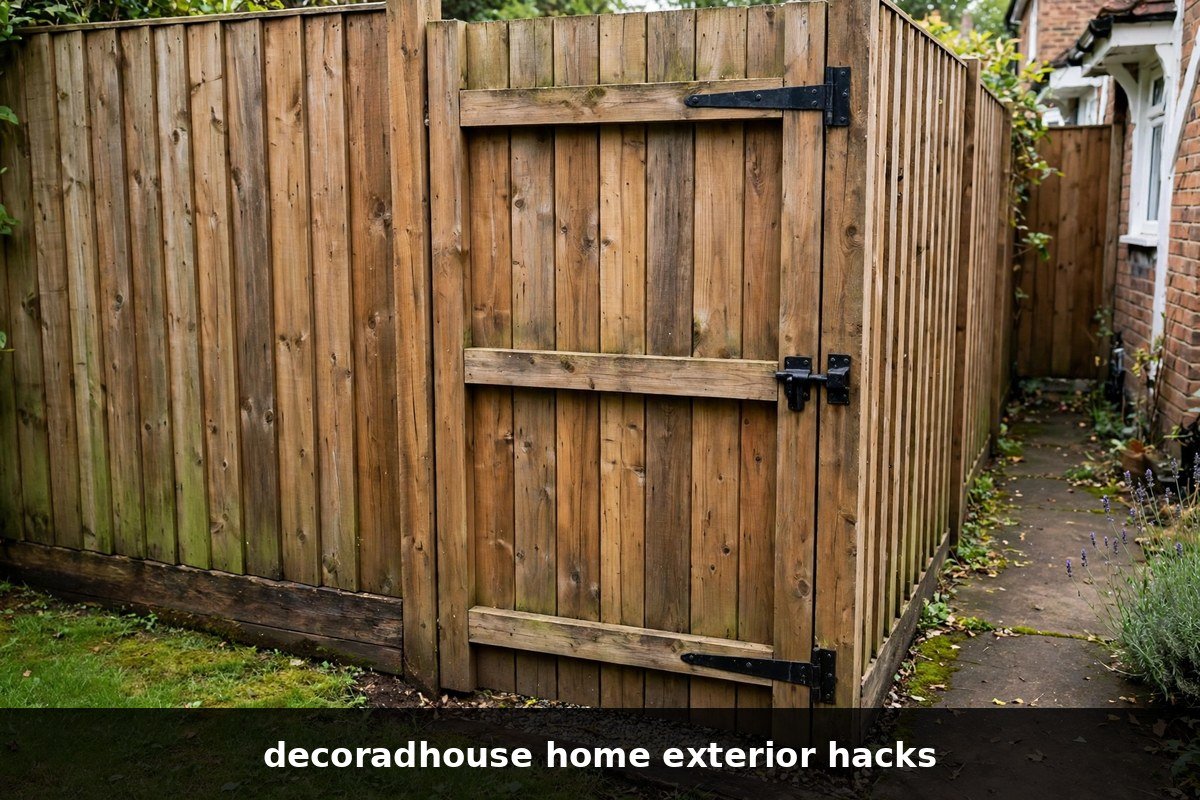
The gate takes the day’s only real carpentry, and it divides into alignment and furniture. A gate that sags is usually a hinge problem wearing a gate’s face: check the diagonal — a sound gate has a brace running from the low hinge side upward to the latch side — then the hinge screws, which work loose in soft or rotten wood and hold in sound wood with longer screws. A gate that binds at the latch often needs the latch repositioned by millimetres rather than the gate rebuilt; a gate whose post moves when pushed is not a hack candidate at all, because the post is the foundation and foundations are renovation.
For the fence itself, the day’s honest scope is panels and counts: replacing a blown-out panel, tightening a gravel board, treating sound wood that has weathered grey. This is where the gate’s companion tool earns its place — run the full boundary length and panel width through the Fence Calculator before ordering, because a fence is bought in panels, posts and gravel boards counted from the measured run, and the traditional method of counting from the garden chair under-orders by exactly the panel that turns a finished day into a half-finished fence.
| Order in the day | Job | Why it stands in this position |
|---|---|---|
| First | Door preparation and first coat | Paint needs the day’s full drying window; starting it early buys the second coat |
| Second | Path edging, sweeping, single-slab repairs | Messy work done before the door’s second coat is at risk from boots and barrows |
| Third | Gate alignment and fence panel work | Carpentry in full daylight, while measurements can still be rechecked at the shop |
| Fourth | Door second coat and furniture | The door is handled last among the dusty jobs, once, with clean hands |
| Last, at dusk | House numbers and entry lighting | Both can only be judged in the light — or the dark — they will actually work in |
How Do Numbers and Lighting Finish the Approach?
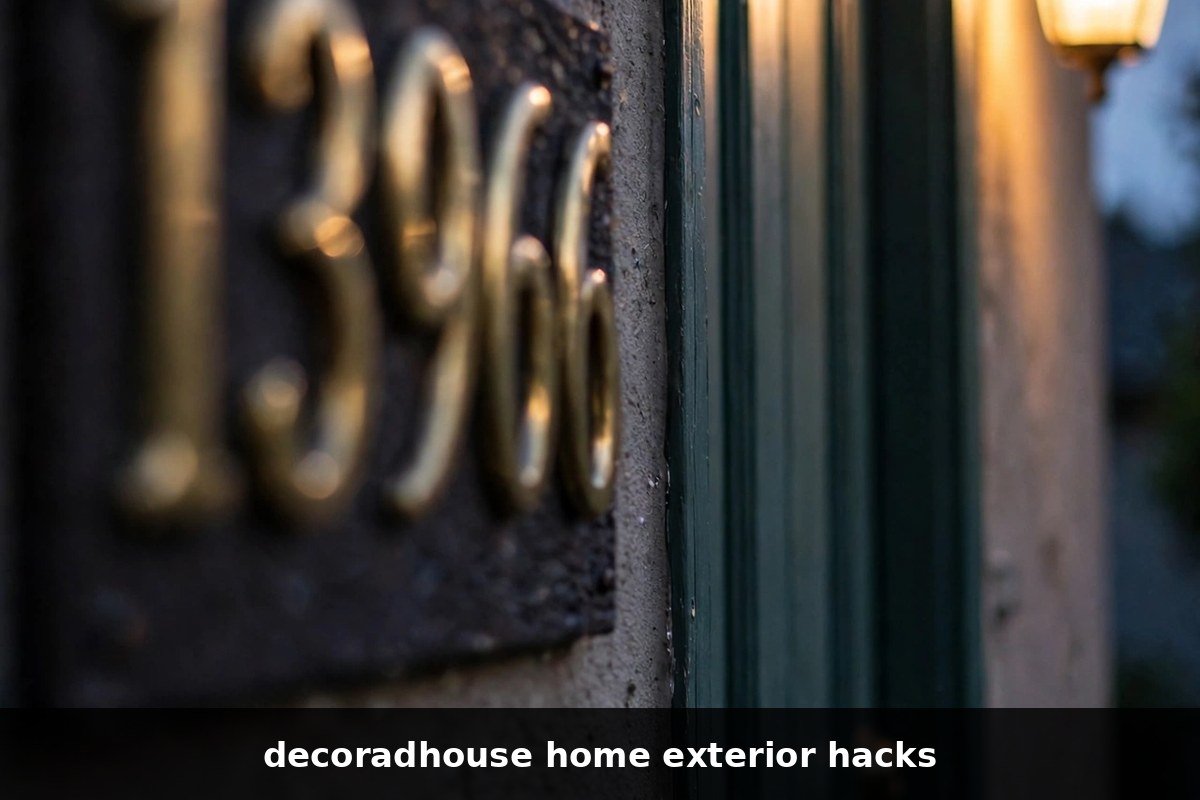
House numbers are a legibility problem before they are a style choice, and legibility has a measurement: numerals need to be readable from the street by a driver or a delivery rider who is not looking for your house in particular. As a working rule, figures around ten centimetres tall read from a typical front-garden distance, and the test costs nothing — fix them temporarily, walk to the street, and read them at the speed of someone passing. Contrast does more than size: pale numerals on pale render fail at any height, and a dark plaque behind light figures, or the reverse, is the hack inside the hack.
Placement is the second half: numbers belong where a stranger’s eye lands, which is beside the door at standing eye height, lit by the entry light after dark — not centred decoratively on a wall the eye must search. If the house has a gate or a long path, the number’s job doubles, and a second set at the gate earns its screws.
Lighting finishes the day because it can only be judged at its end. The entry light’s work is practical: the keyhole, the step edge and the visitor’s face lit without glare, which means a fitting positioned beside rather than above the door, shaded so its light falls on the approach instead of into eyes. Swapping a fitting for a like-for-like replacement is a hack-scale job for a competent householder with the power off and the instructions followed; anything beyond that — new cable runs, new positions, outdoor circuits — is an electrician’s work, and the hack day ends exactly where that line begins. Solar path lights earn a cautious place as the zero-wiring option: staked in an afternoon, honest in summer, dimmer in the deep of winter — a seasoning fact to accept rather than a fault to discover. Finishes only stay finished if the upkeep follows, which is the territory of maintenance hacks that prevent decay.
The Limits of Entry-Zone Hacks
Hacks polish; they do not repair. A painted door over a rotting bottom rail is a season’s disguise, render that is blown will keep shedding whatever is planted in front of it, and a fence aligned on a post that moves is a diary entry, not a fix. The entry zone also flatters its own importance: visitors forgive a plain approach to a warm house far sooner than the reverse — which is why the honest sequence, whenever inspection finds real faults on the approach, is to spend the maintenance day first and hold the hack day in reserve as its reward.
Permissions set a second limit. Front fences, walls and gates near a highway commonly have height rules, and some houses — listed buildings, conservation areas, properties under management-company covenants — restrict colours, fittings and even numerals. The check is quick and belongs before the paint is mixed, because a hack that must be undone is the most expensive kind.
The third limit is weather, and it is absolute: exterior paint has a temperature and dryness window printed on its tin, and a hack day scheduled against that window produces a door that cures badly and peels early. The entry zone will keep for a better Saturday; paint chemistry will not negotiate.
Frequently Asked Questions
How long does painting a front door actually take?
Painting itself occupies the least of it — the day belongs to preparation, and to standing back while coats dry. Washing, sanding, masking and a first coat fill the morning, the second coat follows after the manufacturer’s stated recoat interval, and the door should hang unhandled — furniture off, no closing against fresh seals — for the curing time on the tin. Planned that way it is one day; rushed into one afternoon it is a door that sticks to its frame and carries the frame’s paint away as a souvenir.
What size should house numbers be?
Big enough to be read from the street at passing speed, which for a typical front garden means figures of roughly ten centimetres or more, in strong contrast with what stands behind them. The reliable test is empirical rather than numerical: mount them temporarily, stand where a delivery rider stands, and read. If you have to walk halfway up the path, the numbers — or their contrast, or their lighting — are too small.
Can I replace a fence panel myself?
A standard panel into sound posts, yes — it is a lift, a slot and a fix, made easier by a second pair of hands because panels are awkward rather than heavy. The honest pre-checks are the posts: sound, vertical and at the right spacing for the panel’s true width, measured rather than assumed. If a post moves, leans or is rotten at the ground line, the job has changed genre from hack to repair, and the panel will only be as straight as what holds it.
Do solar lights actually work along a path?
Well enough for guidance, not for illumination — and the distinction decides whether they disappoint. Good solar stakes in an unshaded position will mark a path’s edges through a summer evening reliably and a winter one briefly, because their charge is the day’s light and winter days are short. For the step edge and the keyhole, where light has a safety job, a wired fitting does the work; solar is the garnish, not the course.
If I only have two hours, which hack comes first?
The door’s furniture and the numbers — the two things a visitor touches and reads. A handle set that closes cleanly and numerals that can be found transform the arrival’s evidence out of proportion to their cost, and both fit inside two hours with time to sweep the path on the way back in. Paint is the bigger transformation, but it is a day’s promise, and a hack half-promised is worse than a smaller one kept.
Conclusion
Gathered together, decoradhouse home exterior hacks amount to a single disciplined day: the door painted and sealed, the path edged, the gate trued, the fence counted honestly, and the numbers and light judged at dusk by the people who must find them. None of it is renovation, and that is its strength — the approach a visitor meets can be renewed in a day, provided the measurements come before the purchases and the repairs were never disguised as hacks. You will find more down-to-earth home advice, measured before it is written, at smart decoratoradvice.
2 comments