

Decoration begins where renovation ends: on a patio whose surface and drainage are already sound, everything that makes it inviting is placed, not built. The patio decoration decoradhouse here zones that surface, scales its furniture, and layers textiles and planting — each piece sized from the patio’s real dimensions.
Key Takeaways
- Decoration is everything that can be carried in: if a change needs a mixer, a saw or a skip, it is renovation wearing decoration’s clothes.
- Zone the patio by use before buying anything, and size the zones from the patio’s actual area — circulation is a zone too, and it is not negotiable.
- Furniture is scaled to the surface: footprints and clearances measured first, the anchor piece chosen once, everything else in its service.
- Textiles and planting are the decoration’s soft layers — outdoor-rated, movable, and tied by colour to the house the patio serves.
- Decoration cannot fix slope, drainage or a failing surface; the limits section names what must be repaired before it can be decorated.
What Is Patio Decoration — and What Is It Not?
A decorated patio and a renovated one can look identical in a photograph, and the difference matters because it decides the budget, the timescale and who does the work. Renovation builds the patio: it sets the surface, corrects the fall so water leaves, and lays out the structure — heavy, permanent, priced by the square metre. Decoration furnishes the patio that renovation, or an earlier builder, already left sound: the furniture, the textiles, the planting, the objects — everything that arrives by carrying rather than by construction, and can leave the same way when taste or season changes.
The patio decoration decoradhouse in this article therefore works under one admission test for every idea: can it be carried in by two people and carried out again without a tool touching the surface? If yes, it is decoration and belongs here. If it needs the surface lifted, the level changed or a drain moved, it is renovation — valuable work, but a different article’s work, and decoration attempted on top of its unfinished business is money spent decorating a problem.
That boundary is liberating rather than limiting, because decoration’s whole power is its reversibility. A zone can be rearranged in an afternoon, a colour scheme replaced with the cushions, a planting scheme rebuilt pot by pot — the patio becomes the one part of the house where experimenting is cheap, provided the experiments are measured. Which is the article’s second rule: decoration is placed, but it is placed from dimensions, not from photographs of other people’s patios. Where the surface itself fails that admission test, the work stops being decoration and becomes renovating the patio in outdoor order, drainage and surface first.
How Do You Divide the Patio Into Zones That Earn Their Space?
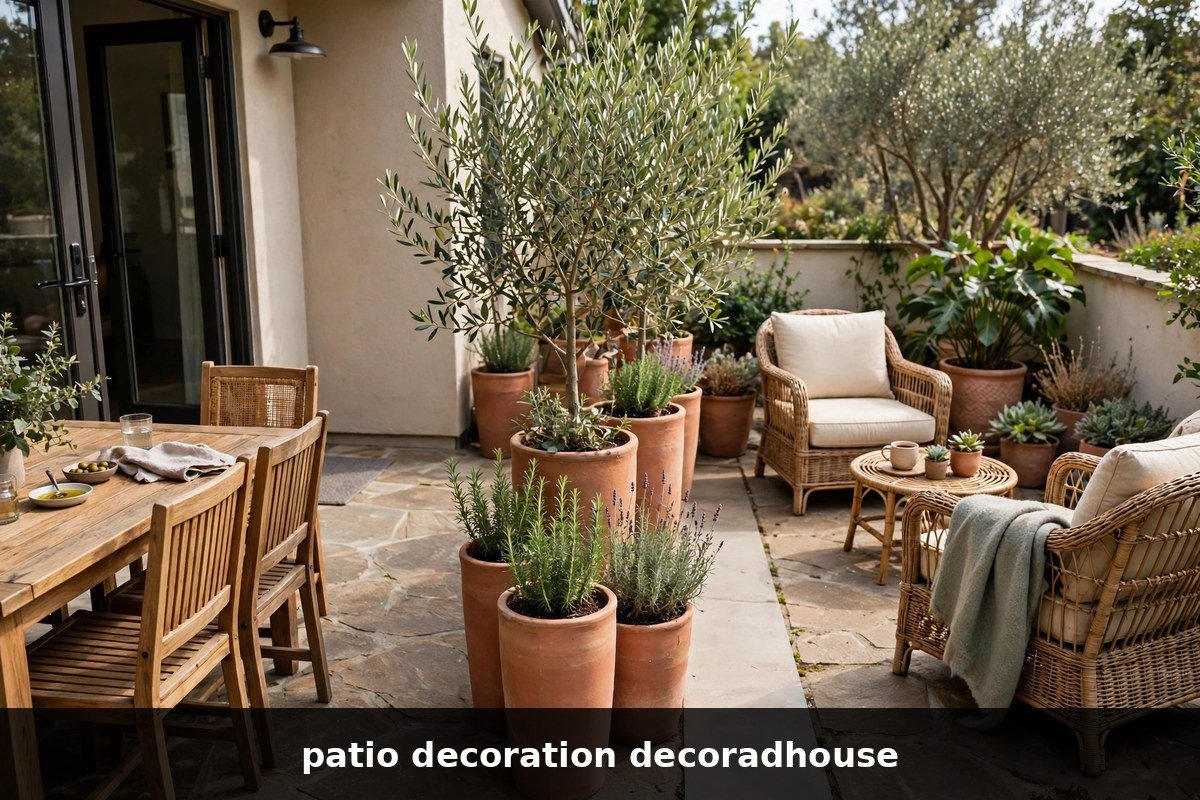
Every patio, whatever its size, is asked to hold some mixture of the same four uses — eating, lounging, planting, and passing through — and decoration fails most often by forgetting the fourth. Zones are how the uses stop competing: a dining zone sized to its table and the chairs’ working room, a lounging zone sized to its seats and the legs they stretch into, planting held at the edges where it frames rather than obstructs, and a circulation zone — the route from door to garden, kept clear as deliberately as any room’s hallway — running through all of it.
Measure before zoning: the patio’s length and width, run through the Square Footage Calculator, give the total area the zones must share, and the shares discipline the ambitions. A dining set that needs a three-metre square for chairs to slide and people to pass behind them cannot be wished into a two-metre patio; the honest decoration of a small surface is one zone done completely — a bistro corner with planting — rather than three zones each missing their clearances. Write the zones on the measurement, with the circulation route drawn first, because a route decided last is a route that runs through the dining chairs.
| Zone | What it must contain | The clearance that makes it work |
|---|---|---|
| Dining | Table, chairs, the serving route from the door | Room behind each chair for it to slide and a person to pass |
| Lounging | Seats angled to each other and to the view, a surface for drinks | Leg room in front of every seat; no seat marooned facing a wall |
| Planting | Pots grouped at edges and corners, in odd numbers and varied heights | Kept out of the circulation route and off the drainage’s path |
| Circulation | The door-to-garden route, unobstructed end to end | A clear path wide enough for a carried tray, in the dark, from memory |
On larger patios the zones gain a further instrument: separation without walls. A rug under the lounging seats, a row of tall pots behind the dining chairs, a change of level used rather than levelled — each tells the body which room it is in while the eye still takes the patio whole. Decoration that zones well is recognisable by a simple test: a guest who has never visited can see where to sit, where to eat and how to reach the garden without being told.
How Should Furniture Be Scaled and Placed?
Outdoor furniture is sold in photographs without dimensions and bought by households with patios of every size, which is why the tape measure is decoration’s first tool. The discipline is footprints: every piece’s length and width, drawn to scale on the zone plan — paper and pencil serve — with its working clearance around it. A chair is not its seat’s width; it is that width plus the space its sitter’s elbows, the slide back, and the passer-by require. Furniture that fits its drawing fits the patio; furniture bought on hope is returned at the cost of the summer’s first fortnight, or kept at the cost of every meal eaten sideways.
Choose the anchor first — the dining table or the principal seats, whichever the household’s patio life centres on — and let it be the zone’s fixed point, bought once and well. Everything else is chosen in its service and at its scale: side tables that reach the seats they serve, storage that swallows the cushions it will actually be given, a bench that can migrate between zones as numbers change. Mixed materials are welcome — timber, metal, woven synthetics each bring a texture — provided the palette holds them in one family and the care they demand is care the household will honestly give, because a teak bench’s tenth year depends on attentions its first year promised.
Placement follows the sun and the door more than the photograph. Seats belong where the household’s actual hours are — morning coffee in the east’s early light, evening chairs where the last sun lands — and the dining zone within an easy, level carry of the kitchen door, because a beautiful table thirty steps and two levels from the kitchen will be eaten at twice a season. Decoration placed against the household’s real routes decays into scenery; placed along them, it becomes the most used room the house has.
What Do Textiles, Planting and Objects Add?
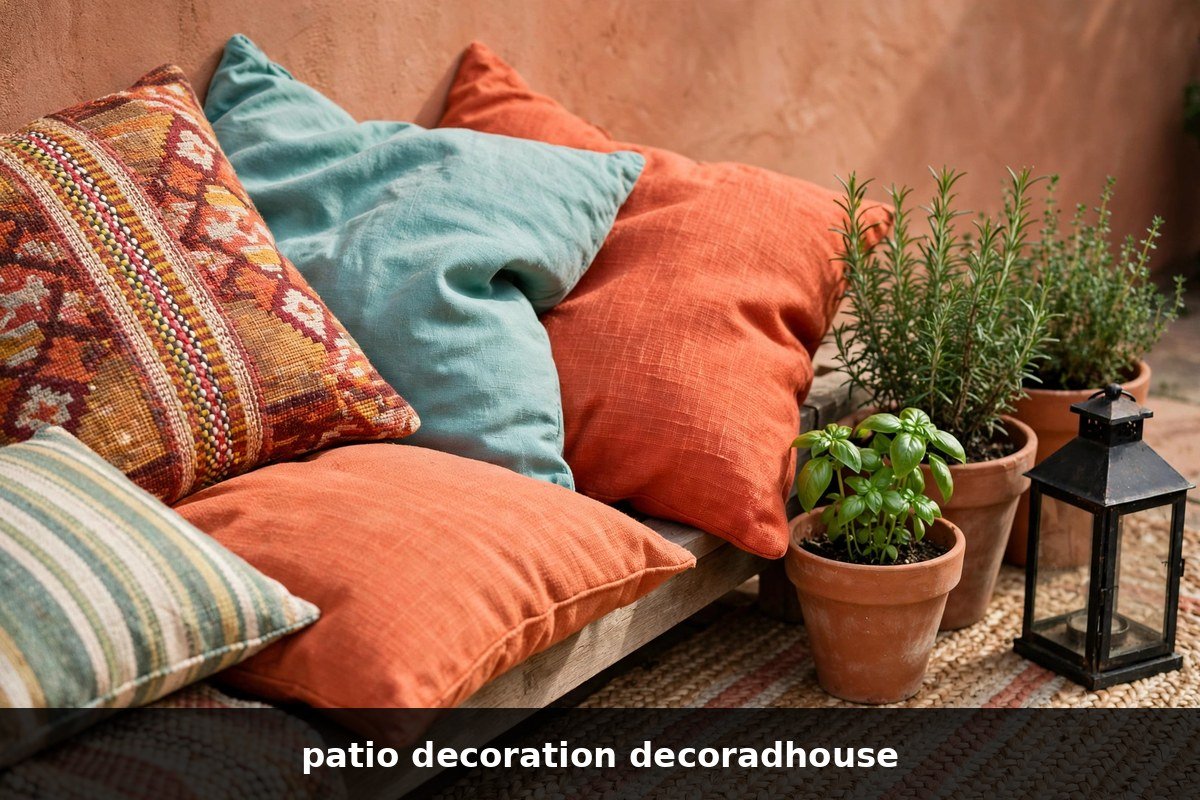
Textiles are the layer that turns furniture into a room: cushions that make a hard bench an evening’s seat, an outdoor rug that gathers the lounging zone and hushes its acoustics, a shade cloth or umbrella that makes noon usable. Their specification is the section’s whole discipline — outdoor-rated fabrics, made to shed water and resist the sun’s bleaching, with covers that come off for washing and cushions light enough to be carried in when the weather turns, because the household that must wrestle its textiles will leave them out to rot instead. Colour is where textiles earn their keep twice over: they carry the scheme, chosen against the house’s facade palette so the patio reads as the house extended — a cushion in the front door’s accent is a small, deliberate rhyme — and they carry its changeability, since next year’s scheme is a set of covers, not a set of furniture.
Planting in decoration is portable architecture: pots and planters that make green walls where no bed exists, screen a neighbour’s window, mark the circulation route’s edge, and soften the surface’s hard geometry. Group them as furniture is grouped — in clusters of varied height at the zones’ edges rather than in a dotted line around the perimeter — and size the pots to the plants’ adult ambitions and the household’s watering honesty, because a large pot forgives a missed day and a small one does not. The plants themselves are chosen for the patio’s own light, which the zones already mapped: sun traps and shade corners are different countries, and decoration that plants by the label’s photograph rather than the patio’s aspect is gardening by obituary.
| Material | Where it earns its place on the patio | Its weakness, priced in |
|---|---|---|
| Outdoor-rated fabric | Cushions, rugs, shade — the layers touched daily | Fades and mildews if left out through wet seasons |
| Timber | Benches, tables — warmth under hand and eye | Needs its oil or accepts silvering; heavy to move |
| Powder-coated metal | Frames and slim pieces in small zones | Chips at the edges invite rust if untended |
| Woven synthetic | Seats that live outside all season | Cheap versions sag; the weave traps crumbs and seeds |
| Terracotta and stone pots | Planting with weight the wind respects | Frost can crack terracotta; stone is a two-person lift |
Objects close the scheme, and restraint is their rule: a lantern group, one piece of wall decor on the house’s wall, the herb pots by the door — each visible because the count is small. The decorated patio that fails by excess is a commoner sight than the one that fails by emptiness, and its cure is subtraction, an object at a time, until each remaining piece can be seen again. Evening is when the decorated patio is judged, and its light deserves the same layering as any room’s — layered lighting, room by room closes with the porch and garden zone where this patio sits.
How Does the Decoration Survive the Seasons?
A patio’s decoration is the only furnishing in the house with weather as a housemate, so its scheme must include its own calendar. Cushions and fabrics have a home indoors or in the storage the plan already bought, and they go there at the season’s turn and on the eve of serious storms, not after the first soaking teaches the lesson. Furniture is covered or carried according to its material’s honest tolerance — the table in the materials section was chosen with this day in mind — and the covers themselves are part of the decoration’s budget, bought with the furniture rather than improvised from tarpaulins in November.
The turning seasons are also decoration’s editing opportunities. Spring’s setup is the annual audit: what rotted, what faded past dignity, which zone was actually used and which was scenery — answered honestly, the audit shrinks the scheme toward the household’s real life, and the patio that emerges is smaller, better and cheaper to keep. Autumn’s close-down writes the list of what next year needs, while the failures are still visible rather than fondly misremembered. Decoration maintained on that rhythm does not accumulate; it matures.
The Limits of Decoration
Decoration’s limits are the surface’s truths, and the first is water: a patio that ponds, drains toward the house, or grows algae in its falls will defeat every layer placed on it, textiles first. Those are renovation’s diagnoses, and no arrangement of furniture, however measured, decorates a drainage fault into invisibility — the honest sequence is repair the water, then decorate the dry. A failing surface states the same limit from below: rocking slabs and crumbling joints are structure, and styling them is staging a photograph over a problem that will be priced later with interest.
Weight and height set the second limit. Raised decks and balconies have load capacities that generous stone planters and a full dining set can approach faster than intuition suggests, and overhead decoration — pergola cloths, hanging planters, festoon anything — answers to fixings, wind and the wall’s willingness to hold, none of which are decoration’s to assume. Fire is the third: any flame on the patio, from a fire bowl to a cluster of candles, obeys clearances from fabrics, fences and overhangs that the scheme must draw before the first evening, not negotiate during it.
Neighbours close the list, as they did for the facade: a patio is overlooked and overheard, and decoration that includes sound, tall screening or structures near the boundary lives within rules and courtesies that vary by street. The scheme that checks them first decorates in peace; the one that discovers them decorates twice.
Frequently Asked Questions
How do I decorate a very small patio?
Give it one zone and finish that zone completely. A small surface holding a bistro set, three good pots and a cushion in the house’s accent colour reads as a designed room, while the same surface attempting dining, lounging and a herb garden reads as storage. Fold-down and stackable pieces earn their place here, the circulation route is drawn first and defended ruthlessly, and vertical surfaces — the wall, the fence — take the planting and decor the floor has no room for.
What colours should patio decoration use?
The house’s own palette, extended: the facade’s field and trim as the decoration’s neutrals, its accent — very often the front door’s colour — repeated once or twice in textiles or pots, and planting supplying the greens no scheme has to buy. A patio coloured independently of its house looks like a showroom delivered to the wrong address; a patio coloured as the house’s last room needs no other justification, and its textiles can change the accent far more cheaply than the door can.
Can I use indoor furniture and cushions outside?
For an afternoon, anything can visit the patio; for a season, indoor pieces are on borrowed time — fabrics that hold water, fillings that mildew, timber and glues never made for wetting and baking in rotation. The economics are worse than the aesthetics: one wet month can write off a good indoor chair, while outdoor-rated equivalents are built to be hosed, baked and left. Borrow for the party if you must, and carry it in before the dew; furnish with what belongs there.
How many pots are too many?
More than the watering rhythm can keep alive and the circulation route can spare. The working test is care, not count: pots grouped in clusters at the zones’ edges, each sized generously enough to forgive a missed day, will thrive at almost any number the edges honestly hold; pots dotted singly around the perimeter, each small and thirsty, become a daily chore with leaves. When a new pot’s arrival means an old route narrows or a watering round lengthens past what happens, the patio is full.
What is the first piece to buy?
The anchor of the zone the household will use most — usually the dining table or the principal seats — bought once, at the measured scale, after the zones are drawn. Everything else in decoration is comparatively cheap, changeable and forgiving of error; the anchor is none of those, and it fixes the scheme’s dimensions, palette and budget for years. Measuring twice and buying the anchor once is the whole method in miniature, and it is why the tape measure precedes the catalogue in every section of this article.
Conclusion
Gathered onto one surface, patio decoration decoradhouse is the art of the placed rather than the built: zones drawn from the patio’s real area, furniture scaled to its drawing, textiles and planting carrying the colour, and a calendar that keeps it all alive — on a surface sound enough to deserve it. A patio finished that way stops being the house’s leftover slab and becomes its most used room. That habit — measuring before furnishing — runs through everything at smart decoratoradvice.


1 comment